


GEO Agency London: How to Optimise Your Brand for AI Search
Your website gets visitors.
Your Google Analytics shows traffic.
Your social media posts are bringing people to your site.
But there is one problem:
Nobody is filling out the form, calling your business or asking for a quote.
Sound familiar?
You are not alone.
Getting website traffic is only one part of digital marketing. The real goal for most businesses is to turn that traffic into leads, enquiries and customers.
If people are visiting your website but not taking action, there is usually a reason.
It could be your messaging. It could be your website design. It could be slow loading speed. Your visitors may not trust your business yet. Or you may simply be attracting the wrong audience.
The good news is that most of these problems can be identified and improved.
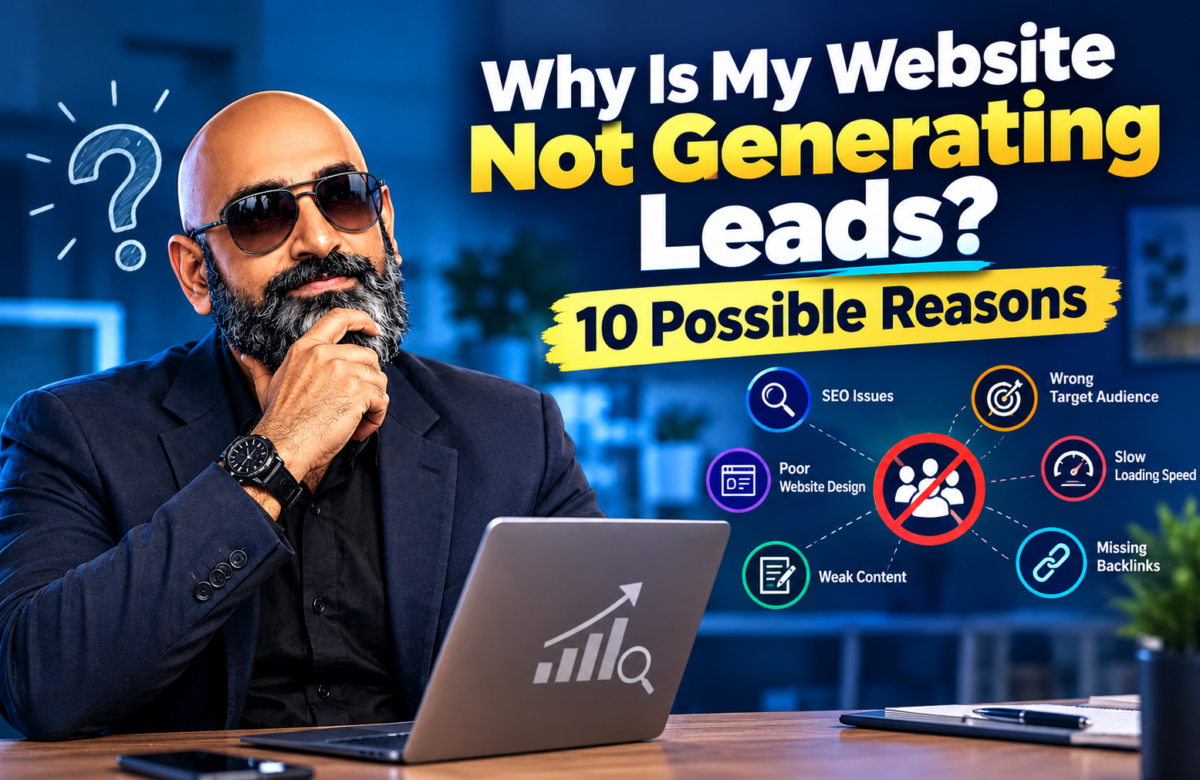
In this guide, we explain 10 common reasons why a website is not generating leads and what you can do about them.
What Is a Website Lead?
Before looking at the problems, it is useful to understand what a lead actually means.
A website lead is a visitor who takes an action that shows genuine interest in your business.
Examples include:
- Filling out a contact form
- Requesting a quote
- Booking a consultation
- Calling your business
- Sending an enquiry
- Signing up for a relevant service
- Downloading a useful resource
- Starting a conversation through live chat
The exact conversion depends on your business.
For a PR agency, a lead might be someone requesting a consultation.
For an e-commerce company, it may be a purchase.
For a B2B company, it could be a demo request.
The important point is:
Traffic is not the same as leads.
Why Is My Website Getting Traffic but No Leads?
There are many possible reasons.
Here are 10 of the most common.
- Your Website Does Not Clearly Explain What You Offer
One of the biggest problems is unclear messaging.
A visitor lands on your homepage and still cannot answer:
What does this company actually do?
If the answer is not obvious, people may leave.
Your homepage should quickly communicate:
What you do + Who you help + Why customers should choose you
For example, instead of saying:
“We create powerful solutions for modern businesses.”
A clearer message would be:
“We are a London PR agency helping businesses build media coverage, brand awareness and thought leadership.”
The second statement is much easier to understand.
How to fix it
Review your homepage and ask:
- Is our main service obvious?
- Is our target customer clear?
- Can someone understand our value in a few seconds?
- Does the headline explain the benefit?
- Is there a clear next step?
If not, your messaging may be costing you leads.
- You Are Attracting the Wrong Visitors
More traffic does not automatically mean more leads.
You could receive thousands of visitors every month and still generate very few enquiries if those visitors are not your target audience.
For example, imagine a London PR agency receives traffic from people searching:
“What is PR?”
That visitor may only be looking for information.
Another person searches:
“PR agency London pricing”
That person may be much closer to making a buying decision.
These visitors have different levels of intent.
How to fix it
Look at:
- Search queries
- Landing pages
- Traffic sources
- Location
- Audience segments
- Engagement
- Conversion data
Then identify which traffic sources produce the best leads.
Your goal should not simply be:
More visitors
It should be:
More relevant visitors.
- Your Calls to Action Are Weak
Imagine someone visits your service page.
They like what they see.
They want to contact you.
But there is no obvious next step.
That is a missed opportunity.
Your website should make it easy for visitors to take action.
Useful calls to action include:
- Book a Consultation
- Request a Quote
- Talk to an Expert
- Get Started
- Contact Our Team
- Request a Proposal
- Book a Call
The CTA should also match the visitor’s intent.
Someone reading an educational blog may not be ready to “Buy Now”.
A softer CTA may work better:
“Talk to Our SEO Team”
or
“Get a Free Website Review”
How to fix it
Review your key pages.
Ask:
What do I want the visitor to do next?
Then make that action obvious.
- Your Website Is Too Slow
People are impatient online.
If a page takes too long to load, visitors may leave before they even see your offer.
Slow websites can create problems for both:
User experience
and
Search performance
Common causes include:
- Large images
- Too many scripts
- Poor hosting
- Unoptimised code
- Heavy plugins
- Third-party tools
- Poor mobile optimisation
How to fix it
Review your website performance, especially on mobile.
Look at:
- Largest Contentful Paint
- Interaction to Next Paint
- Cumulative Layout Shift
- Image size
- JavaScript
- CSS
- Server response time
Do not focus only on achieving a perfect technical score.
The bigger goal is:
Make the website fast and comfortable to use.
- Your Website Does Not Build Enough Trust
Imagine you are considering two agencies.
Agency A has a basic website with little information.
Agency B has:
- Client testimonials
- Case studies
- Media coverage
- Team profiles
- Industry experience
- Clear contact details
- Detailed service information
Which one would you trust?
Most people would feel more comfortable with Agency B.
Visitors need evidence before they make decisions.
Add trust signals such as:
- Genuine testimonials
- Case studies
- Client logos where permitted
- Awards
- Industry memberships
- Media coverage
- Expert profiles
- Reviews
- Results and examples
Avoid making claims that you cannot support.
Real evidence is more powerful than exaggerated marketing language.
- Your Content Talks About You Instead of the Customer
This is a common website problem.
A page may contain paragraphs about:
“Our company.”
“Our team.”
“Our approach.”
“Our experience.”
But the visitor is thinking:
“How can you help me?”
Good marketing content connects your service to the customer’s problem.
Instead of only saying:
“We provide digital PR services.”
explain:
“Our digital PR campaigns help businesses earn relevant media coverage, build brand awareness and strengthen their online authority.”
The second version focuses more clearly on the customer’s potential outcome.
A simple content formula
Try:
Customer problem → Your solution → Benefits → Evidence → Next step
This structure can make service pages more persuasive.
- Your Contact Form Is Asking for Too Much Information
Have you ever clicked a contact form and found 15 required fields?
It can feel like work.
A complicated form may reduce conversions.
You may not need:
- Full address
- Company size
- Phone number
- Job title
- Multiple dropdowns
- Detailed project information
at the first stage.
Keep the first step simple
Depending on your business, you may only need:
- Name
- Company
- Brief requirement
You can collect more information later.
The right form length depends on the type of lead you want, but the principle is simple:
Only ask for information you actually need.
- Your Website Is Difficult to Use on Mobile
A large share of web traffic comes from smartphones.
If your website looks good on desktop but is difficult to use on mobile, you may lose potential customers.
Check:
- Text size
- Button size
- Menu navigation
- Form fields
- Image layout
- Page spacing
- Pop-ups
- Sticky elements
Try using your website on your own phone.
Can you easily:
Find the service → Understand the offer → Contact the business?
If not, your mobile experience needs attention.
- Your Landing Pages Are Not Matching Search Intent
Someone searches for:
“PR agency London”
and lands on a page that talks mainly about:
“Our company history.”
There is a mismatch.
The visitor wanted to understand your PR services.
Your landing page should match the reason they arrived.
For a commercial search, include:
- Clear service explanation
- Benefits
- Relevant experience
- Proof
- Process
- FAQs
- Pricing guidance where appropriate
- Clear CTA
For an informational search, provide useful educational content and guide the visitor towards relevant services naturally.
Think about the question behind the search.
Then answer that question.
- You Are Not Tracking Your Conversions Properly
This problem is easy to miss.
You may actually be generating leads—but your analytics setup is not recording them correctly.
For example:
A visitor submits a form.
The form reaches your sales team.
But Google Analytics does not record the conversion.
Your report then shows:
0 leads
even though your business received enquiries.
That creates a completely wrong picture.
Check your tracking
Make sure important actions are measured, such as:
- Form submissions
- Phone clicks
- Email clicks
- WhatsApp clicks
- Consultation bookings
- Quote requests
- Downloads
- Chat interactions
Also check whether duplicate events or incorrect event triggers are creating misleading numbers.
Good tracking helps you understand what is actually working.
Your Website May Have a Conversion Problem, Not a Traffic Problem
This is an important distinction.
Suppose your website receives:
10,000 visitors
but only generates:
10 leads
Your first thought may be:
“We need more traffic.”
But what if the website could generate 50 leads from the same traffic after improving its conversion rate?
That could be a much better opportunity.
For example:
Before
10,000 visitors
10 leads
0.1% conversion rate
After
10,000 visitors
50 leads
0.5% conversion rate
You did not need 40,000 additional visitors.
You needed a better website experience.
This is why conversion rate optimisation (CRO) matters.
How to Find Where Visitors Are Dropping Off
Use your analytics data to understand the customer journey.
A simple funnel might look like:
Landing Page
↓
Service Page
↓
Contact Page
↓
Form Start
↓
Form Submission
↓
Lead
If a large number of users reach the contact page but very few submit the form, the problem may be:
- Form length
- Lack of trust
- Weak CTA
- Technical issue
- Poor messaging
- Unexpected requirements
If visitors leave immediately after landing, investigate:
- Page speed
- Search intent
- Messaging
- Design
- Content relevance
Data can help you find the actual problem instead of guessing.
How SEO Can Help Generate More Leads
SEO should not be treated only as a ranking exercise.
The real business objective should be:
Reach the right people → Answer their questions → Build trust → Encourage action
For example, a London PR agency could target searches around:
- PR agency London
- Digital PR agency London
- B2B PR agency London
- Technology PR agency London
- PR agency pricing
- How to choose a PR agency
- Digital PR benefits
Each keyword represents a different type of intent.
Create content for different stages of the customer journey.
Awareness
What is digital PR?
Consideration
What are the benefits of digital PR?
Comparison
Digital PR vs traditional PR
Commercial
Digital PR agency London
Decision
How much does a digital PR agency cost?
This creates a clearer path from search to enquiry.
How AI Search Can Influence Lead Generation
Search is also becoming more conversational.
People may ask AI-powered search tools:
“Which PR agencies in London are good for B2B technology companies?”
The answer may include several brands.
This means businesses should also think about:
AI Search Visibility
A strong AI search strategy can involve:
- Clear website information
- Helpful content
- Strong brand identity
- Expert content
- Digital PR
- Original research
- Relevant third-party coverage
- Consistent business information
The objective is not to manipulate AI results.
It is to build a brand that has genuine expertise and useful information associated with it.
Content Alone Cannot Fix a Poor Website
You can publish hundreds of blogs.
But if your website:
- Loads slowly
- Is confusing
- Has weak CTAs
- Lacks trust signals
- Has difficult forms
- Does not explain your services
you may still struggle to generate leads.
Think of the process as:
Traffic → Landing Page → Trust → Value → CTA → Conversion
Every stage matters.
If one stage breaks, the whole journey can suffer.
A Simple Website Lead Generation Checklist
Use this checklist to review your website.
Messaging
- Is it clear what we offer?
- Is our target customer obvious?
- Is our value proposition easy to understand?
SEO
- Are we targeting relevant searches?
- Does our content match search intent?
- Are our important service pages optimised?
Content
- Does the content answer customer questions?
- Is it easy to read?
- Does it demonstrate expertise?
Trust
- Do we have genuine testimonials?
- Do we show case studies?
- Do we demonstrate experience?
Conversion
- Are CTAs clear?
- Are contact forms simple?
- Is the next step obvious?
Technical
- Is the website fast?
- Does it work well on mobile?
- Are there broken pages or technical issues?
Analytics
- Are form submissions tracked?
- Are calls and important clicks tracked?
- Can we see the full conversion journey?
If you find several “no” answers, you have a good starting point for improvement.
What Should You Fix First?
Do not try to change everything at once.
Start with the biggest problems.
Priority 1: Technical Problems
Fix anything preventing visitors from using the website.
Priority 2: Messaging
Make your offer clear.
Priority 3: Conversion Paths
Improve CTAs and forms.
Priority 4: Trust
Add genuine proof.
Priority 5: Content
Create useful content based on customer needs.
Priority 6: Traffic Quality
Make sure you are attracting the right audience.
This approach is usually more useful than simply publishing more content.
How Xclusive PR Agency London Can Help
Generating leads from a website requires more than driving traffic.
It requires a connected strategy across:
SEO + Content + Digital PR + Brand Visibility + Conversion Optimisation
At Xclusive PR Agency London, businesses can approach lead generation by looking at the entire customer journey.
That can include:
- SEO strategy
- Content marketing
- Digital PR
- AI search optimisation
- Brand positioning
- Thought leadership
- Website content
- Search intent research
- Conversion-focused landing pages
- Performance measurement
The aim is not simply to bring more people to your website.
It is to bring the right people and give them a clear reason to take the next step.
Final Thoughts
If your website is not generating leads, do not immediately assume that you need more traffic.
First, find out why visitors are not converting.
Maybe your messaging is unclear.
Maybe your visitors are not the right audience.
Maybe your website is too slow.
Maybe your forms are too complicated.
Maybe there is not enough trust.
Maybe your CTA is easy to miss.
Or perhaps your tracking is not working properly.
The good news is that these problems can be investigated.
Start with your data.
Understand your audience.
Review your website.
Test your pages.
Improve the customer journey.
Then measure the results.
The goal should not be:
“How can I get more website visitors?”
The better question is:
“How can I turn more of the right visitors into genuine leads?”
That shift in thinking can make your website a much stronger part of your marketing strategy.

