


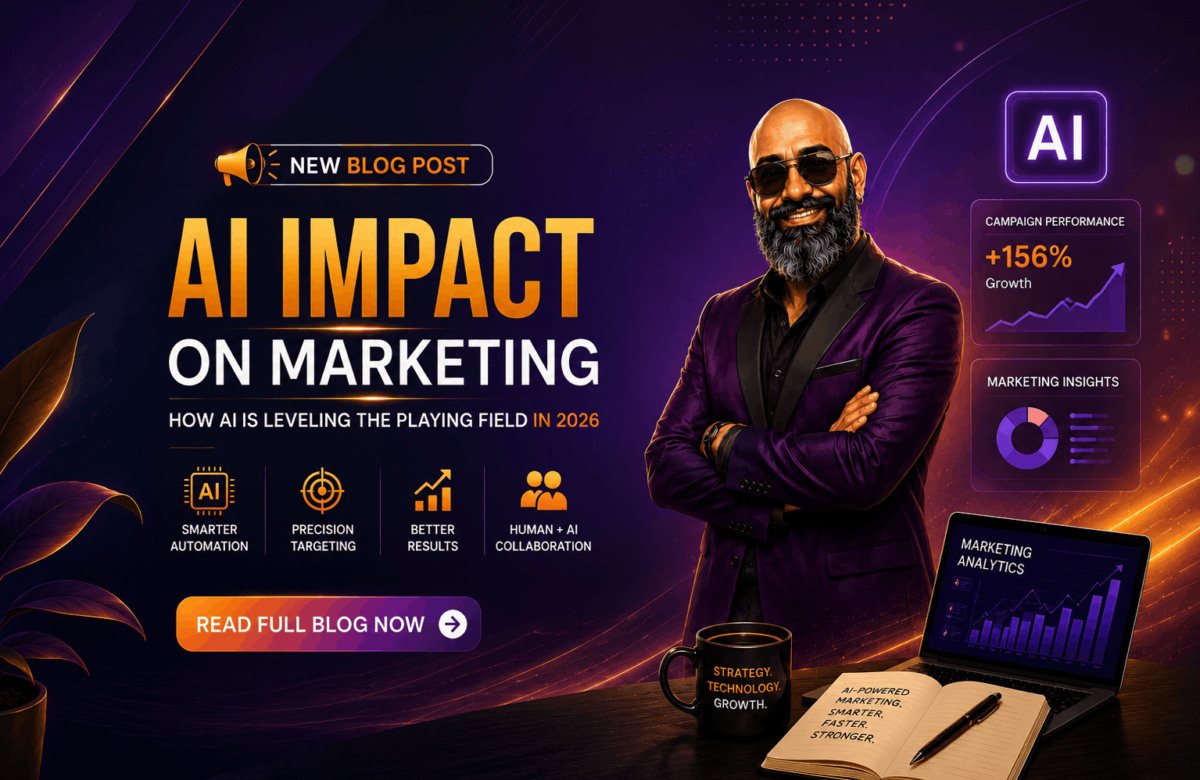
AI Impact on Marketing 2026: Strategy for Small Businesses London
The 2026 Marketing Revolution – How AI is Leveling the Playing Field
The AI impact on marketing in 2026 is nothing short of transformative. Once the preserve of multinational corporations with six‑figure budgets, artificial intelligence is now accessible to anyone with an internet connection and a clear AI marketing strategy.
For small businesses in London, this shift represents a historic opportunity. Tools that cost less than £50 per month are enabling local shops, agencies, and service providers to compete directly with enterprise‑level rivals. Across the UK, 34% of small and medium‑sized enterprises (SMEs) now use AI tools – up from just 12% in 2024.
In this guide, we’ll show you exactly how to build a winning AI marketing strategy tailored for London’s unique small business ecosystem.
The Great Marketing Transformation (2026 Data)
AI is no longer a side project. According to Jasper’s State of AI in Marketing 2026 report (based on 1,400 marketing professionals):
-
91% of marketing teams now use AI – up from 63% one year ago.
-
95% of marketers plan to increase AI spending in 2026.
-
66% expect to allocate 10% or more of their marketing budget to AI.
-
Global AI in Marketing market is projected to reach $217.33 billion by 2034.
💡 Productivity Gains
Businesses using AI report completing the same work in 23% less time. Half of marketers say AI helps them bring work to market faster. For a busy London small business, that productivity boost can mean the difference between surviving and thriving.
AI Marketing Strategy: Beyond the Hype (2026 Framework)
An effective AI marketing strategy in 2026 focuses on autonomous execution, not just content generation.
1. From Co‑pilots to AI Agents
You no longer ask AI to write an email. You assign it an objective: “Increase retention by 5%.” The AI agent then:
-
Analyzes churn data
-
Drafts the email
-
A/B tests subject lines
-
Sends to at‑risk segments
-
Reports ROI
62% of CMOs say AI‑driven automation has forced them to rethink roles and flatten organisational structures. — Gartner
2. Generative Engine Optimization (GEO)
Traditional SEO is not enough. People now ask AI engines (ChatGPT, Perplexity, Google AI Overviews) for synthesised answers. If your brand isn’t “understood” by large language models, you are invisible.
Key GEO tactics:
-
Cite authoritative sources clearly.
-
Use robust schema markup (JSON‑LD).
-
Provide direct, concise answers that can be extracted as citations.
For small businesses in London, GEO is a massive opportunity to appear alongside much larger competitors in AI‑generated answers.
3. Hyper‑Personalisation at Scale
Static segments are dead. AI enables the “Segment of One” – real‑time personalisation for each customer based on live behaviour, preferences, and intent signals.
Real‑time personalisation delivers the highest media ROI, especially on retail media networks.
4. Governance is the #1 Challenge
Legal and brand review processes are now the primary blockers to AI deployment. High‑performing organisations are solving this by:
-
Creating clear AI standards for marketing.
-
Embedding brand governance from the start of workflows.
-
Establishing shared guardrails with legal and compliance teams.
Marketing for Small Businesses in London: The Great Leveling
For London’s small business community, AI represents the most significant levelling technology ever seen.
Adoption Among UK SMEs
-
34% of UK SMEs now use AI tools (Federation of Small Businesses).
-
54% of small business owners already use AI marketing tools.
-
27% plan to adopt them in 2026.
-
45% use AI to analyse data trends.
-
44% use AI to write copy for emails and other content.
-
40% use AI to create images and visuals (Constant Contact).
What’s Actually Working for Small Businesses
| Use Case | Impact |
|---|---|
| Content production | From 1 blog post/month to weekly posts. AI handles drafts; humans handle editing and expertise. |
| Customer communication | Email response time reduced from 24 hours to <2 hours using AI‑assisted drafting. |
| Lead qualification | AI scores leads by conversion likelihood. One professional services firm saw 40% higher conversion rates. |
Accessible AI Tools for Small Businesses (2026)
-
Pomelli (Google Labs + DeepMind) – Creates on‑brand marketing content, campaigns, and even full websites from your existing URL.
-
Mailchimp’s AI – Email timing and personalisation.
-
Canva Magic Studio – Quick visual assets.
-
ChatGPT (free tier) – Strategy support and coding help.
The barrier is no longer cost – most tools cost less than a mobile phone contract. The barrier is knowledge.
London‑Specific AI Marketing Services
A growing ecosystem of London‑based agencies now specialises in:
-
AI‑powered SEO, GEO, and AEO (Answer Engine Optimisation)
-
Generative AI strategy
-
Visibility across Google AI Overviews, ChatGPT, and Perplexity
The London Business School has also launched Agent Lunar – an AI‑enhanced, all‑in‑one marketing platform for small businesses.
Challenges & Ethical Considerations (2026)
The Trust Recession
Global time spent on social media is declining:
-
Facebook engagement -36%
-
Instagram -16%
-
TikTok -34%
-
X (Twitter) -50%
Audiences are tired of bots, misinformation, and AI‑generated visuals. Every brand must ask: Where is the boundary between enhancement and deception?
By end of 2026, 60% of CMOs will adopt technologies to protect brands from GenAI‑driven deception. — IAB
Avoiding AI Homogenisation
Generic AI content is everywhere. The brands that win will be those producing memorable, human‑led, culturally resonant work – not the most content.
Proving ROI Remains Hard
Only 41% of marketers can confidently prove AI ROI (down from 49% last year). However, among those who can prove it, 60% report at least 2x returns (and 79% for enterprises >$10B revenue).
For small businesses: track real business outcomes – customer acquisition, conversion rates, revenue growth – not just hours saved.
The Future of AI Marketing (2027–2028)
-
Agentic AI as Operating System – By 2028, 60% of brands will use agentic AI for one‑to‑one interactions (Gartner).
-
The Human Premium – By 2027, brands will allocate 50% of influencer budgets to creator authenticity.
-
Ambient Experiences – By 2028, 30% of brand experiences will happen through smart devices (voice, ambient discovery).
Conclusion: Your Next Step
AI has moved from experimental to foundational. For small businesses in London, this is an unprecedented chance to compete with larger rivals on a level playing field. The tools are affordable, the productivity gains are real, and the barriers to entry are falling fast.
The question is no longer whether to use AI in marketing. It’s whether you’ll use it well enough to stay ahead.
👉 Ready to build your AI marketing strategy? [Contact our team] or [download our free AI readiness checklist].
References (Sources)
-
Federation of Small Businesses (FSB). (2026). UK SME AI Adoption Survey.
-
Constant Contact. (2026). Small Business Now Report.
-
Google Labs & DeepMind. (2026). Pomelli AI Marketing Tool Launch.
-
IAB (Interactive Advertising Bureau). (2026). AI Transparency and Disclosure Framework.
-
London Business School. – How UK SMEs using AI to compete large Rivals in 2026
-
Statista / Market Research Future. (2026). AI in Marketing Market Size Projection.

