


AI Search Optimisation: The Future of SEO in the UK
What Is AI Search Optimisation?
AI Search Optimisation (ASO) is the process of improving a website’s ability to be discovered, understood, trusted and recommended by AI-powered search engines such as Google AI Overviews, Google AI Mode, ChatGPT Search, Gemini, Perplexity and Microsoft Copilot.
Unlike traditional SEO, which primarily focuses on improving rankings in search engine results pages (SERPs), AI Search Optimisation focuses on increasing the likelihood that an AI system will reference, summarise or recommend your content when answering a user’s question.
An effective AI Search Optimisation strategy combines technical SEO, Entity SEO, topical authority, structured data, EEAT (Experience, Expertise, Authoritativeness and Trustworthiness), Digital PR and high-quality content to establish your website as a reliable source of information.
Why AI Search Is Changing SEO Forever
For more than two decades, businesses measured SEO success by one metric: ranking on Google’s first page. While search rankings remain important, the rise of AI-powered search has introduced a new objective: becoming a trusted source that AI systems choose to reference and recommend.
Today, millions of users ask conversational questions instead of typing short keywords. Whether using Google AI Overviews, ChatGPT Search, Gemini or Perplexity, users increasingly expect direct answers rather than lists of web pages. As a result, visibility is no longer determined solely by ranking position. It is also influenced by authority, relevance, factual accuracy and how easily AI systems can interpret and trust your content.
For UK businesses, this represents a significant opportunity. Organisations that invest in AI Search Optimisation today can build stronger digital authority, improve brand visibility and increase the likelihood of being recommended across multiple AI-powered search platforms as adoption continues to grow.
How AI Search Engines Work
Unlike traditional search engines that primarily return a list of ranked web pages, AI-powered search engines are designed to understand questions, retrieve the most relevant information from multiple trusted sources, and generate a conversational response.
When a user asks a question such as “What is the best SEO agency in London?”, AI systems don’t simply select the website ranking in the first position. Instead, they evaluate multiple sources, compare the information available, identify trusted entities, and generate an answer based on relevance, authority, freshness, and credibility.
Although each platform uses its own technology, most AI-powered search experiences follow a similar process:
- Understand the user’s intent rather than just matching keywords.
- Retrieve information from authoritative and relevant sources.
- Compare multiple perspectives to improve factual accuracy.
- Generate a concise response using trusted information.
- Cite or recommend the sources that provide the highest value.
For businesses, this means success depends on more than keyword rankings. Your website must become a trusted, well-structured, and authoritative source that AI systems can confidently understand and reference.
Traditional SEO vs AI Search Optimisation
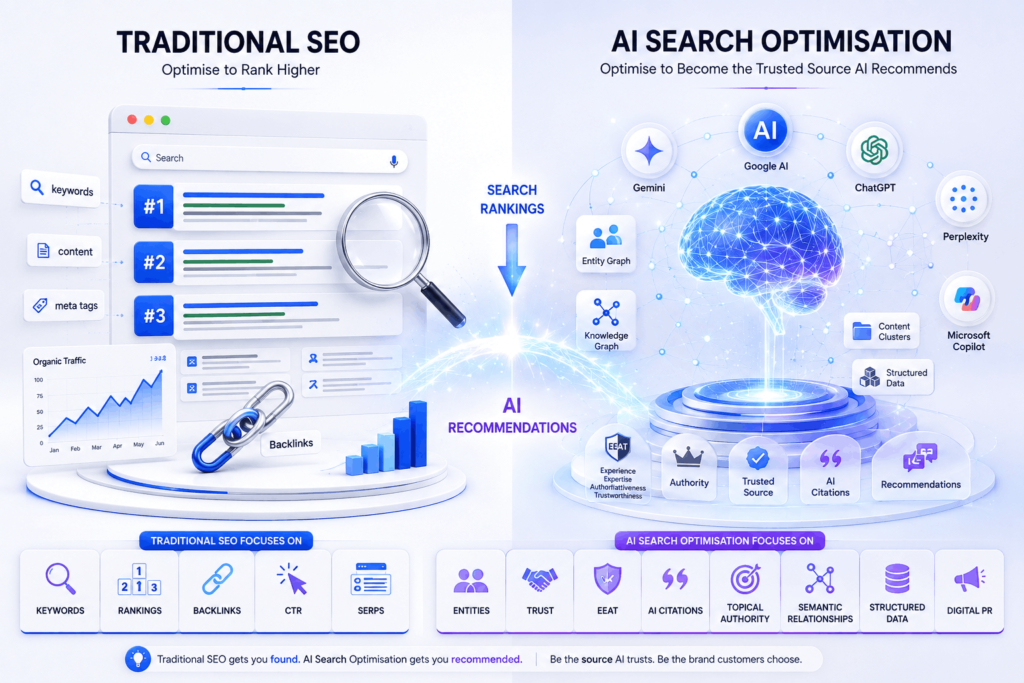
Traditional SEO
Traditional SEO focuses on improving a website’s visibility in search engine results pages by optimising keywords, backlinks, technical performance, and user experience.
AI Search Optimisation
AI Search Optimisation focuses on making content understandable, trustworthy, and easy for AI systems to retrieve, summarise, and recommend. It combines traditional SEO with Entity SEO, EEAT, structured data, topical authority, Digital PR, and semantic content architecture.
Key Difference
Traditional SEO aims to rank web pages.
AI Search Optimisation aims to become the source that AI platforms trust enough to recommend.
Which AI Platforms Should Businesses Optimise For?
This is a high-value, LLM-friendly section because it clearly identifies the ecosystem.
Businesses should optimise their digital presence for multiple AI-powered platforms, including:
- Google AI Overviews
- Google AI Mode
- ChatGPT Search
- Google Gemini
- Microsoft Copilot
- Perplexity AI
- Claude AI
Although each platform retrieves information differently, they all reward similar characteristics:
- trustworthy information
- authoritative brands
- structured content
- topical expertise
- strong entity signals
- accurate citations
- excellent user experience
Optimising for these principles improves visibility across the broader AI search ecosystem rather than a single platform
ow AI Search Engines Decide Which Websites to Recommend
Artificial intelligence doesn’t rank websites in the same way as traditional search engines. Instead of simply evaluating keywords and backlinks, AI-powered search platforms analyse a combination of trust, authority, context and relevance before deciding which sources to reference in their responses.
Whether someone searches using Google AI Overviews, ChatGPT Search, Gemini, Microsoft Copilot or Perplexity, the goal is the same: provide the most accurate, trustworthy and helpful answer by drawing information from reliable sources.
Although each platform uses different technologies and retrieval methods, they generally evaluate websites using similar quality signals.
1. Authority & Brand Trust
AI search engines are more likely to recommend businesses that have established themselves as recognised authorities within their industry.
Authority is built through consistent publication of high-quality content, expert insights, editorial backlinks, digital PR, positive brand mentions, customer reviews and a strong online reputation.
For example, a healthcare website that regularly publishes expert-reviewed medical content and earns citations from respected organisations is more likely to be referenced than a website with limited credibility.
Key Signals
- Strong brand recognition
- High-quality editorial backlinks
- Digital PR coverage
- Positive online reputation
- Trusted author profiles
- Industry recognition
2. Experience, Expertise, Authoritativeness & Trustworthiness (EEAT)
Google’s EEAT framework plays a significant role in helping AI systems determine whether content is reliable.
Content created by experienced professionals, supported by factual information and published on trustworthy websites is more likely to be referenced by AI-powered search platforms.
Businesses should clearly demonstrate:
- Real-world experience
- Subject matter expertise
- Transparent authorship
- Trustworthy business information
- Accurate and regularly updated content
3. Topical Authority
Rather than publishing isolated blog posts, AI search engines favour websites that comprehensively cover a subject.
A website with 50 interconnected articles about SEO is generally considered more authoritative than one with only a few generic marketing articles.
Topical authority demonstrates depth of knowledge and helps AI systems understand that your website is a reliable source within a specific niche.
4. Entity Recognition
Modern AI systems understand entities, not just keywords.
An entity can be a person, business, location, service, product or concept that has a clear identity and relationship with other entities.
For example:
- XclusivePR → Organisation
- Raj Singh → Person
- London → Location
- SEO → Service
- Digital PR → Service
Strengthening these relationships through structured content and schema markup makes it easier for AI systems to understand your business and recommend it accurately.
5. Content Quality & Information Gain
AI systems don’t reward content simply because it’s longer. They prioritise pages that provide unique insights, practical expertise and information not widely available elsewhere.
Content that demonstrates original thinking, real-world examples, proprietary frameworks or case studies is far more likely to be referenced than articles that repeat existing information.
Ask yourself:
“Does this page teach something genuinely new?”
If the answer is yes, you’re far more likely to become a trusted source.
6. Structured Data & Machine Readability
AI search engines rely on well-structured content to understand context efficiently.
Clear headings, logical content hierarchy, descriptive image alt text, FAQ sections and structured data all improve machine readability.
Implementing schema such as:
- Article
- FAQ
- Organisation
- Person
- Service
- Breadcrumb
- ImageObject
helps search engines interpret your content more accurately.
7. Freshness & Accuracy
AI platforms prioritise information that is both current and accurate, particularly for industries where facts change quickly.
Regularly updating cornerstone content, statistics, screenshots, case studies and references signals that your website remains a reliable source of information.
Key Takeaway
Becoming a trusted source for AI-powered search isn’t about optimising for a single algorithm, it’s about building genuine authority. AI search engines reward businesses that consistently demonstrate expertise, publish original insights, maintain a technically sound website and provide information that users can trust
The XclusivePR AI Trust Framework
A memorable six-pillar framework:
- Authority – Build recognised expertise in your niche.
- Trust – Strengthen EEAT with transparent authorship and credibility signals.
- Entities – Establish clear relationships between your brand, people, services and locations.
- Knowledge – Create comprehensive topical clusters with original insights.
- Structure – Improve machine readability through schema, semantic HTML and internal linking.
- Recognition – Earn mentions, citations and digital PR that reinforce your authority.
10 Proven Strategies to Optimise Your Website for AI Search
Knowing how AI search works is only the first step. The real challenge is implementing a strategy that helps your website become a trusted source across Google AI Overviews, ChatGPT, Gemini, Microsoft Copilot and other AI-powered search platforms.
While every AI model uses its own retrieval and ranking methods, they consistently reward websites that demonstrate expertise, trust, authority and exceptional user value.
The following strategies form the foundation of a modern AI Search Optimisation strategy.
1. Build Topical Authority Instead of Publishing Random Content
Publishing isolated blog posts is no longer enough.
AI search engines are far more likely to recommend websites that comprehensively cover a topic through interconnected content.
Instead of creating articles on unrelated subjects, organise your content into topic clusters supported by a central pillar page. This helps AI systems understand your depth of expertise and strengthens your authority within a specific niche.
Example
Pillar Topic: SEO Services
Supporting Content:
- Technical SEO
- Local SEO
- Ecommerce SEO
- International SEO
- Entity SEO
- AI Search Optimisation
- Digital PR
- SEO Case Studies
- Core Web Vitals
- Keyword Research
The stronger your topical coverage, the easier it becomes for AI systems to recognise your website as an authoritative source.
2. Create Content That Answers Questions Directly
AI-powered search engines are designed to deliver immediate answers.
Content that clearly answers specific questions is far more likely to be retrieved than content filled with lengthy introductions or unnecessary filler.
A practical structure for every section is:
- Start with a direct answer.
- Explain the concept in simple language.
- Provide supporting examples.
- Include actionable recommendations.
- Add frequently asked questions where appropriate.
This approach benefits both users and AI systems by making information easier to understand and reference.
Strengthen Entity SEO
Keywords help search engines understand individual pages.
Entities help AI systems understand your entire business.
Clearly define your:
- Organisation
- Services
- Team members
- Office locations
- Industry expertise
- Products
- Brand relationships
Support these entities with structured data, internal links and consistent information across your website.
The stronger your entity relationships, the easier it becomes for AI systems to establish trust in your brand.
4. Demonstrate Real Experience
AI platforms increasingly favour content created by people with genuine experience.
Rather than rewriting information already available online, publish content based on real-world knowledge.
Examples include:
- Client case studies
- Original research
- Industry insights
- Practical frameworks
- Lessons learned
- Before-and-after results
- Expert commentary
Original content provides “information gain”, a key factor that makes your content more valuable than generic articles.
5. Optimise Content for Machine Readability
AI systems process content differently from humans.
Clear structure improves comprehension.
Use:
- Descriptive headings
- Short paragraphs
- Bullet points
- Numbered steps
- Comparison sections
- Definitions
- FAQs
- Summary boxes
Avoid large blocks of text that make important information difficult to extract.
6. Implement Structured Data
Structured data provides additional context about your content.
Depending on the page, implement schema such as:
- Organisation
- Person
- Article
- Service
- FAQPage
- BreadcrumbList
- LocalBusiness
- Review
- ImageObject
- VideoObject
Schema doesn’t guarantee AI citations, but it significantly improves machine understanding.
7. Build Digital Authority Beyond Your Website
AI systems evaluate your overall online presence, not just your website.
Strengthen your authority through:
- Editorial backlinks
- Digital PR
- Podcast appearances
- Expert interviews
- Industry publications
- Business directories
- Awards
- Professional memberships
These external signals reinforce your credibility and increase the likelihood of being recommended.
8. Improve Technical SEO
Even the best content may struggle if technical foundations are weak.
Prioritise:
- Core Web Vitals
- Fast loading times
- Mobile optimisation
- HTTPS
- Crawlability
- Clean site architecture
- XML sitemaps
- Canonical tags
- Internal linking
- Accessibility
Technical excellence helps AI systems crawl and interpret your website efficiently.
9. Keep Content Fresh
AI search platforms prefer content that reflects current information.
Review cornerstone pages regularly to:
- Update statistics
- Refresh screenshots
- Expand sections
- Add recent examples
- Remove outdated references
- Improve internal links
Fresh, well-maintained content signals ongoing expertise.
10. Build a Recognisable Brand
Brands matter more than ever in AI search.
Businesses that consistently publish valuable content, earn industry recognition and build trust across multiple channels are more likely to become recommended sources.
Invest in:
- Consistent branding
- Expert authorship
- Customer reviews
- Public relations
- Community engagement
- Thought leadership
- Original research
Strong brands are easier for AI systems to identify, understand and trust.
How AI Understands Your Business Through Entity Relationships
AI search engines don’t view your website as a collection of isolated pages. Instead, they build a network of connected entities that helps them understand who you are, what you do, where you operate and why your business is authoritative.
Think of your website as a digital knowledge graph. Every page, service, author, location and customer success story strengthens the relationships AI uses to evaluate your expertise.
For example, when AI understands that XclusivePR is a London-based digital marketing agency, Raj Singh is its founder, SEO and Digital PR are core services, and the business has published authoritative case studies and earned trusted mentions, it can confidently associate those entities together. The stronger these connections become, the more likely AI platforms are to recommend your business when users search for relevant services.
The illustration below shows how a modern AI knowledge graph connects multiple entities to build a complete understanding of a brand rather than relying on keywords alone.
How EEAT Builds Trust in AI Search
AI search is designed to provide users with useful and reliable information. For businesses competing for visibility in AI powered search, simply publishing content is not enough. Your website needs to demonstrate genuine experience, subject expertise, authority and trustworthiness.
This is where EEAT, which stands for Experience, Expertise, Authoritativeness and Trustworthiness, becomes important.
EEAT is not a single optimisation technique or a formula that guarantees an AI citation. Instead, it provides a useful framework for evaluating the overall credibility of content, its creators and the organisation behind it.
For businesses, the principle is simple:
The easier it is for search engines and AI systems to understand who created your content, why they are qualified to discuss the subject and what evidence supports their claims, the stronger your overall credibility signals become.
Experience
Experience demonstrates that information comes from genuine first hand knowledge rather than being rewritten from other websites.
For a digital marketing agency, experience could include:
- SEO case studies
- Campaign results
- Website audits
- Before and after performance data
- Client success stories
- Original research
- Lessons from real campaigns
- Screenshots of genuine results
- Expert commentary based on practical experience
For example, an article explaining SEO for travel businesses becomes substantially more useful when it includes lessons from an actual travel SEO campaign rather than only generic recommendations.
Information based on real experience gives readers something they cannot easily find by reading ten other articles on the same topic.
Expertise
Expertise answers an important question:
Who actually understands this subject?
Make the expertise behind your content visible.
This can include:
- Detailed author biographies
- Professional qualifications
- Industry experience
- Relevant certifications
- Author pages
- Links to professional profiles
- Expert-reviewed content
- Contributions to industry publications
- Demonstrable specialist knowledge
For XclusivePR, this means connecting relevant content with identifiable professionals who have genuine experience in SEO, Digital Marketing, PR and related disciplines.
Authoritativeness
Authority develops through recognition.
A business can demonstrate authority through a combination of signals across its website and the wider web.
Examples include:
- Reputable editorial mentions
- Industry publications
- Expert interviews
- Digital PR coverage
- High quality backlinks
- Industry awards
- Professional memberships
- Original research
- Recognised experts
- Strong client case studies
- Consistent brand mentions
This is where SEO and Digital PR work together.
Your website can explain what you know, but external recognition helps establish that your expertise is recognised beyond your own website.
Trustworthiness
Trust is arguably the most important component of EEAT.
A website should make it easy for users to determine:
- Who operates the business
- How they can contact the organisation
- Where the business is based
- Who created the content
- When the content was published or updated
- Where factual claims came from
- Whether commercial relationships are disclosed
- Whether customer information is handled securely
For businesses operating in the UK, this can also include clear company information, contact details, relevant legal pages, privacy information and consistent business details across reputable platforms.

