


Answer Engine Optimisation (AEO): How UK Businesses Can Get Found in Google AI Overviews, ChatGPT & Social Search
AEO: How to Optimise Your Business for AI Search in 2026
Search is changing.
People are no longer relying solely on traditional Google search results to find businesses, compare services or answer important questions. They are increasingly using conversational search, AI-powered search experiences and social platforms to research what to buy, who to trust and which business to choose.
For businesses in the UK, particularly those competing in a crowded market such as London, this creates a new challenge.
How do you make your business visible when customers are asking platforms for answers rather than simply searching for websites?
This is where AEO (Answer Engine Optimization) comes into the conversation.
AEO is the process of optimising useful, trustworthy content so search engines and AI-powered answer experiences can better understand and surface relevant information for users..
However, AEO is not a replacement for SEO.
The strongest approach combines SEO, helpful content, topical authority, technical optimisation, digital PR, social media, local SEO and brand authority to create a digital presence that can be understood across different search and discovery environments.
For example, a potential client may traditionally search for:
“SEO agency London”
But their next search could be:
“How do I choose an SEO agency for my London business?”
Or they might ask an AI platform:
“What should a small business look for when hiring an SEO agency in the UK?”
These searches have different wording, but they often represent the same underlying customer journey: the person is trying to find a trustworthy business that can solve a particular problem.
That is why modern search visibility is becoming less about targeting individual keywords in isolation and more about building genuine authority around the topics, services and questions that matter to your audience.
At XclusivePR, we believe this shift creates a significant opportunity for UK businesses.
Rather than trying to find shortcuts to make an AI platform mention a brand, businesses should focus on building a credible and consistent presence across their website, search results, social channels, digital PR and other relevant online sources.
This guide explains what AEO means, how it differs from SEO and GEO, how social media and digital PR fit into the picture, and what UK businesses can do to strengthen their visibility across traditional and AI-powered search.
Most importantly, it explains how to approach AEO as part of a long-term digital marketing strategy designed not only to increase visibility, but also to build trust, generate qualified leads and support sustainable business growth.
What Is AEO (Answer Engine Optimisation)?
Answer Engine Optimisation (AEO) is the process of creating and structuring useful, trustworthy content so that search engines and AI-powered search experiences can better understand, retrieve and present information when people ask questions online.
In simple terms, SEO helps people discover your website through search, while AEO focuses on making your information clear and useful when a search experience is designed to provide an answer.
This distinction is becoming increasingly important as search becomes more conversational.
Instead of typing:
“PR agency London”
a potential client might ask:
“How can a London business improve its reputation through digital PR?”
Or:
“What should I look for when choosing a PR agency in the UK?”
These searches are not simply looking for a list of websites. They reflect a specific question, problem or decision that the person is trying to solve.
How Does AEO Work?
AEO starts by understanding the questions your target audience is actually asking.
From there, businesses can create content that provides clear, accurate and genuinely useful answers while demonstrating relevant expertise.
A strong AEO strategy can involve:
- Understanding customer questions and search intent
- Creating helpful, original content
- Answering important questions clearly and directly
- Building comprehensive coverage around important topics
- Connecting related pages through relevant internal links
- Demonstrating first-hand knowledge and expertise
- Supporting claims with reliable sources
- Maintaining accurate business and brand information
- Improving technical SEO and website accessibility
- Building credibility through relevant digital PR and external references
The objective is not to create content simply because a question contains a particular keyword.
The objective is to be genuinely useful when someone needs an answer.
Why Is AEO Different From Traditional Keyword Optimisation?
Traditional keyword optimisation can focus heavily on phrases such as:
“SEO agency London”
“digital marketing agency London”
“PR agency London”
These keywords are still valuable.
However, a customer’s research journey can contain dozens of questions around those services.
For example, someone looking for an SEO agency may also want to know:
- How much does SEO cost in the UK?
- How long does SEO take to produce results?
- What should an SEO agency actually do?
- How can I tell whether an SEO agency is reputable?
- Should a small business invest in local SEO?
- Can SEO help generate leads rather than just traffic?
A business that answers these questions thoroughly can demonstrate considerably more topical expertise than one that simply creates a page targeting the phrase “SEO agency London.”
This is where AEO and modern SEO begin to overlap.
AEO Does Not Mean Writing For AI Instead Of People
One of the most important points for businesses to understand is that AEO should not mean producing content specifically for machines while ignoring the human reader.
Google’s current guidance for AI features continues to emphasise the importance of helpful, reliable, people-first content and established SEO fundamentals. Websites need to remain accessible to search engines, while their content should provide genuine value rather than being created primarily to manipulate search results or AI-generated responses.
That means there is no need to fill an article with repetitive questions, manufacture hundreds of near-identical pages or rely on supposed formulas for getting an AI platform to mention a business.
A better approach is much simpler:
Create the best answer for the person asking the question.
Then make that answer easy for both people and search systems to understand.
Why Context Matters
AEO also requires businesses to think beyond individual pages.
Imagine that a London business publishes an excellent article explaining how digital PR works.
That is useful.
But if the same website also has:
- A detailed PR service page
- Articles about reputation management
- Content about media relations
- Case studies demonstrating real work
- Author information
- Consistent company information
- Relevant external coverage
- Social profiles containing related expertise
the overall website provides considerably more context about the organisation.
The individual article becomes part of a much larger topic and entity ecosystem.
This is why we consider AEO to be closely connected with topical authority, entity SEO and digital PR, rather than treating it as another isolated optimisation tactic.
What Does AEO Mean For A UK Business?
For a UK business, AEO should ultimately answer three questions:
What does your business do?
Your website should make your services, expertise and areas of specialisation immediately clear.
Who do you help?
Your content should demonstrate an understanding of your target customers, industries, locations and problems.
Why should people trust you?
Your website and wider digital presence should provide credible evidence of expertise, experience and authority.
For a London-based business, this could mean developing content around its services, its target industries, its local market and the questions customers commonly ask before making a purchase.
The result is not simply a website containing more keywords.
It is a website that provides more useful information, stronger context and clearer evidence of expertise.
AEO Is Part Of A Bigger Search Strategy
AEO works best when it sits within a wider digital marketing strategy.
Technical SEO helps search engines access and understand your website.
Content demonstrates expertise.
Internal linking connects related information.
Local SEO helps businesses become more relevant for location-based searches.
Digital PR can strengthen external credibility and brand visibility.
Social media helps distribute expertise and create additional opportunities for discovery.
Brand consistency helps people and search systems understand who the business is and what it is known for.
Together, these elements create a stronger foundation for visibility across traditional search, AI-powered search and other digital discovery channels.
For businesses looking at AEO purely as a way to appear in AI-generated answers, that broader perspective is important.
It is about building a credible digital entity that customers can discover, understand and trust across multiple channels.
For businesses in competitive markets such as London, this integrated approach can be particularly valuable because potential customers rarely follow a perfectly linear path from one Google search to a purchase.
They may discover a business through search, read its website, see its LinkedIn content, encounter a media mention, check reviews, and then use an AI platform to compare their options.
The brands that consistently communicate expertise across that journey are better positioned to earn attention and trust.
How Google AI Overviews and AI Mode Are Changing the Search Journey
The way people use Google is changing.
Traditional search often involved entering a keyword, reviewing a list of websites and choosing which result to visit.
AI-powered search can make that journey more conversational.
A user can now begin with a question, explore an answer, ask a follow-up question and continue researching without necessarily following the traditional search-result journey.
For businesses, this means that being visible in search increasingly requires more than targeting individual keywords.
What Are Google AI Overviews?
Google AI Overviews are AI-generated summaries that can appear within Google Search for certain queries.
They are designed to help users understand a topic quickly while providing links to supporting web content that can help them explore the subject further.
Google’s current guidance explains that AI Overviews and AI Mode are part of Google Search and continue to rely on the same fundamental principles that make websites eligible for Search.
For businesses, this means that the fundamentals still matter:
- Your website needs to be crawlable.
- Important pages need to be indexable.
- Content needs to be useful and relevant.
- Pages should provide original value.
- Information should be clear and understandable.
- Internal links should help users and search engines discover related content.
- The website should provide a good overall page experience.
- The business should demonstrate genuine expertise and credibility.
What Is Google AI Mode?
AI Mode provides a more conversational way to explore information through Google Search.
Rather than relying on one short query, users can ask more detailed questions and continue their research through follow-up queries.
For example, someone considering digital marketing services might begin with:
“What is the best digital marketing strategy for a small business?”
They could then ask:
“What if the business is based in London?”
Then:
“Should I invest in SEO or paid advertising?”
And eventually:
“How do I choose a digital marketing agency?”
This creates a much broader customer journey.
A business therefore needs content that can answer questions at different stages rather than relying entirely on one commercial service page.
Why Traditional SEO Still Matters
The arrival of AI search does not mean traditional Google rankings have become irrelevant.
In fact, Google’s guidance makes the opposite point.
The same fundamental SEO practices that help Google discover, understand and index content remain important for AI-powered search experiences.
This means businesses should continue investing in:
- Technical SEO
- Search intent research
- Helpful content
- Internal linking
- Topic clusters
- Local SEO
- Structured data where appropriate
- Page experience
- Digital PR
- Author and business credibility
- Relevant external references
AEO should therefore build on SEO rather than replace it.
Search Intent Is Becoming More Important
One of the biggest opportunities for businesses is understanding the reason behind a search.
Consider the difference between:
“SEO London”
and:
“How much does SEO cost for a small business in London?”
The first query has relatively broad commercial intent.
The second reveals a specific concern.
The person may be trying to understand:
- Whether SEO is affordable
- What determines SEO pricing
- What services are included
- Whether SEO is suitable for their business
- How long they should expect to invest
- What a realistic SEO campaign looks like
A strong content strategy can address those questions directly.
This is where AEO and search intent work together.
The Search Journey Can Become Much Longer
AI-powered search can encourage users to explore a subject through multiple connected questions.
For a potential XclusivePR client, the journey could look something like:
Discovery
“Why isn’t my business appearing on Google?”
↓
Education
“What is SEO and how does it work?”
↓
Evaluation
“Is SEO better than PPC for lead generation?”
↓
Comparison
“What should I look for in an SEO agency?”
↓
Local intent
“What are the best SEO agencies in London?”
↓
Commercial decision
“How much does an SEO agency cost?”
↓
Action
“Book an SEO consultation.”
This is why a single service page rarely answers every question a potential customer has.
Your Website Needs To Support The Entire Journey
A strong AEO and SEO strategy should provide useful information across different stages of the buying process.
Your website should ideally contain:
- Service pages explaining what you offer
- Educational articles answering common questions
- Detailed guides addressing complex topics
- Case studies demonstrating experience
- Author information establishing expertise
- FAQs addressing specific concerns
- Local content where geographic relevance matters
- Trust signals such as testimonials and reviews
- Clear contact and enquiry pathways
These pages should not exist independently.
They should be connected through strategic internal linking so that users can naturally move from learning about a problem to understanding the solution and eventually contacting the business.
AI Search Does Not Remove The Need For Clicks
There is understandable concern that AI-generated answers could reduce website traffic.
However, the objective of modern search visibility should not be reduced to generating the highest possible number of clicks.
A more valuable question for a business is:
Are the right people discovering the brand and moving closer to becoming customers?
For a professional services business, one highly relevant enquiry can be considerably more valuable than hundreds of visits from people who have no intention of buying.
This is why XclusivePR’s approach should focus on:
- Relevant visibility
- Qualified search intent
- Brand discovery
- Expertise
- Trust
- Conversion opportunities
- Lead quality
rather than traffic volume alone.
What This Means For UK Businesses
For UK businesses competing in crowded markets, the shift towards AI-powered search creates both a challenge and an opportunity.
Businesses should focus on building a digital presence that clearly communicates:
- What the business does
- Who it helps
- Where it operates
- What problems it solves
- What expertise it has
- Why customers should trust it
- Where its information comes from
- How potential customers can take the next step
For London businesses in particular, this means combining national expertise with genuine local relevance.
A page targeting “digital marketing agency London” should not simply repeat the location throughout the copy.
It should demonstrate an actual understanding of the London market, the businesses being served, their challenges and the services required to solve those challenges.
The Opportunity For XclusivePR Clients
This is where AEO becomes commercially valuable.
The objective is not to create content simply to appear in an AI-generated answer.
The objective is to build a search ecosystem that supports the entire customer journey.
That ecosystem can include:
- SEO-optimised service pages
- Helpful educational content
- AEO-focused question and answer content
- Local SEO
- Digital PR
- Social media
- Case studies
- Reputation management
- Expert-led thought leadership
- Strategic internal linking
- Conversion-focused landing pages
When these elements work together, a potential customer can encounter the same business repeatedly while researching a problem.
They may discover the brand through Google.
Then encounter an article.
Then see an expert post on LinkedIn.
Then find a media mention.
Then search the brand directly.
Then visit a service page.
Then enquire.
That is
How Can Businesses Optimise Content for AEO and AI Search?
Optimising content for AI search does not mean writing specifically for machines.
It means creating information that is clear, useful, trustworthy, well organised and genuinely relevant to the questions your audience is asking.
Google’s current guidance says that the same foundational SEO best practices remain relevant for AI Overviews and AI Mode. There are no additional technical requirements or special AI markup required to appear in these features. Google recommends focusing on technical accessibility, helpful and reliable people-first content, internal linking, page experience and making important information available in text.
Google: AI features and your website
For businesses, the practical question is therefore:
How can we make our content more useful for both customers and modern search experiences?
Here are the areas we recommend prioritising.
1. Start With Real Customer Questions
Good AEO begins with understanding what your audience actually wants to know.
Do not start by generating hundreds of keywords and turning each one into a separate article.
Instead, identify the questions customers ask before, during and after they consider buying your service.
These questions can come from:
- Sales conversations
- Customer enquiries
- Google Search Console
- Google autocomplete
- People Also Ask results
- Reviews
- Reddit and relevant community discussions
- Social media comments
- Industry forums
- Competitor content gaps
- Internal sales and customer-support teams
For example, a business looking for SEO services may not only search for “SEO agency London.”
They may also ask:
- How much does SEO cost in the UK?
- How long does SEO take?
- Can SEO generate leads?
- What should an SEO agency include?
- How do I know if my SEO campaign is working?
- Should a small business invest in local SEO?
Those questions reveal the customer’s concerns much more clearly than a keyword list alone.
2. Give The Answer Early
If a page is designed to answer a specific question, don’t make the reader search through 1,500 words before reaching the answer.
Lead with a concise explanation.
Then provide the evidence, examples and deeper context underneath it.
For example:
What is AEO?
Answer Engine Optimisation is the process of creating and structuring useful information so that search engines and AI-powered search experiences can better understand and surface relevant answers to users’ questions.
Then explain the concept in greater depth.
This structure benefits the reader because they get the information quickly, while the remainder of the page provides the context required for more complex searches.
3. Build Topic Depth Rather Than Creating Endless Articles
One of the biggest mistakes businesses can make is confusing more content with more authority.
Publishing dozens of short articles targeting tiny variations of the same keyword does not automatically make a website authoritative.
Google’s current guidance specifically warns against creating content primarily to manipulate search rankings or generative AI visibility, including producing large amounts of low-value content around query variations.
A stronger approach is to build meaningful topic coverage.
For example, a digital marketing agency might create a comprehensive AEO resource supported by relevant content covering:
- AEO and SEO
- Google AI Overviews
- AI search
- GEO
- Social SEO
- Digital PR
- Local SEO
- Entity SEO
- Content strategy
- Online reputation
Each piece should provide a genuine reason to exist.
4. Demonstrate First-Hand Experience
This is one of the most important opportunities for XclusivePR.
Businesses should not rely entirely on generic explanations that could have been written by any agency.
Show what you actually know.
That can include:
- Campaign experience
- Case studies
- Original observations
- Industry examples
- Lessons learned
- Expert commentary
- Practical processes
- Before-and-after improvements
- Original research
- Client challenges and solutions
For an agency, this can transform an article from:
“Here is what SEO means.”
into:
“Here is what we have learned from implementing SEO strategies for businesses.”
That difference helps establish a much stronger expert perspective.
5. Make Your Expertise Visible
A reader should be able to understand who is behind important content.
Where appropriate, businesses should provide:
- Author name
- Author biography
- Relevant professional experience
- Links to appropriate professional profiles
- Editorial information
- Business information
- Evidence supporting significant claims
This becomes particularly important for topics where expertise and trust influence purchasing decisions.
For XclusivePR, author-led content can become an important part of the brand’s broader EEAT and entity strategy.
6. Use Clear, Descriptive Headings
Headings should tell the reader exactly what they are about to learn.
Compare:
“The Future”
with:
“How Google AI Overviews Are Changing Search Visibility”
The second heading is much more useful.
It establishes:
- The subject
- The context
- The user’s likely question
- The purpose of the section
Question-led headings can be particularly useful when they naturally reflect how customers search.
7. Create Strong Internal Links
Internal linking is one of the most underused opportunities in content strategy.
A new article should not exist as an isolated piece of content.
It should connect readers to the most relevant supporting information elsewhere on the website.
For example, within an AEO article, relevant internal links could point to:
- SEO services
- Social media marketing
- Public relations
- Local SEO
- AI marketing
- Online reputation management
- Relevant case studies
- Supporting educational articles
The anchor text should describe the destination naturally.
For example:
“SEO services for UK businesses”
is more useful than repeatedly using:
“click here.”
Internal links can help users discover relevant information while also helping search engines understand the relationships between pages.
8. Use External Sources Where They Add Trust
Not every sentence needs an external citation.
But when making an important factual claim, linking to a reliable primary source can strengthen the credibility of the information.
For AEO and AI search content, priority sources include:
- Google Search Central
- Google official announcements
- Bing Webmaster documentation
- UK Government sources
- Relevant regulators
- Recognised industry organisations
- Original research
For example, when discussing Google’s AI search features, we should prioritise Google’s own documentation rather than relying on a third-party SEO blog interpreting it.
This is particularly important in a rapidly changing area such as AI search, where outdated advice can remain online long after Google’s systems have changed.
9. Keep Business Information Consistent
AI-powered search does not exist independently of the wider web.
Your business information should be consistent wherever customers and search systems can encounter it.
This includes:
- Business name
- Website
- Services
- Location
- Contact information
- Company descriptions
- Founder or expert information
- Social profiles
- Business listings
- Relevant third-party profiles
For a London agency, for example, your website should clearly communicate what the company does, which businesses it serves and its relationship with London and the wider UK market.
Consistency helps create a clearer understanding of the business as an entity.
10. Add Original Information Instead of Rewriting Everyone Else
If ten competitors have already published the same definition of AEO, publishing an eleventh version adds limited value.
Ask:
What can we contribute that is genuinely useful?
That might be:
- A new framework
- An original process
- First-hand observations
- A case study
- Original data
- Expert commentary
- A practical checklist
- A real-world example
- A unique comparison
- A perspective based on actual experience
This is particularly important for agencies.
Potential clients don’t simply want to know what SEO or AEO is.
They want to know whether the agency understands how to apply it to a real business.
11. Optimise For The Complete Topic
AEO should not be reduced to inserting question-and-answer blocks into an article.
Search engines increasingly need to understand relationships between concepts.
For this article, for example, AEO is connected to:
SEO
AI search
Google AI Overviews
GEO
Content marketing
Topical authority
Entity SEO
Digital PR
Social media
Local SEO
Brand authority
These relationships should appear naturally throughout the content.
That creates a stronger topical context than repeatedly using the phrase “Answer Engine Optimisation.”
12. Optimise The Page For People First
Ultimately, the best AEO strategy is still good content strategy.
Before publishing a page, ask:
- Does this answer the question?
- Is the information accurate?
- Is anything important missing?
- Does it demonstrate genuine expertise?
- Is the content easy to scan on mobile?
- Are paragraphs short enough to read comfortably?
- Are headings descriptive?
- Are lists used where they improve clarity?
- Are internal links genuinely useful?
- Are important claims supported?
- Does the page give the reader a logical next step?
If the answer is yes, you are building something far more valuable than a page created purely to target an AI search trend.
The XclusivePR Approach
At XclusivePR, we would approach AEO as part of a wider search and digital authority strategy.
That means looking beyond a single article and asking how the entire digital presence works together.
A campaign might combine:
- Technical SEO
- Keyword and search-intent research
- Content strategy
- AEO-focused content
- Internal linking
- Local SEO
- Digital PR
- Social media
- Online reputation management
- Thought leadership
- Conversion optimisation
The objective is not to manufacture an AI citation.
It is to build a business presence that is useful to customers, understandable to search engines and credible across the wider web.
For businesses competing in London and across the UK, that distinction can make the difference between simply publishing content and building a digital asset that consistently supports customer acquisition.
The type of search visibility businesses should be building for in 2026.
Why Social Media Matters for AEO and AI Search Visibility
AEO does not begin and end with your website.
When people research a business today, they can encounter information across Google, AI search experiences, LinkedIn, Instagram, YouTube, industry publications, review platforms and other digital channels.
This makes social media an important part of the wider visibility ecosystem.
However, there is an important distinction to understand.
Social media engagement should not be treated as a direct Google ranking shortcut.
The real value of social media is its ability to distribute expertise, increase brand discovery, create demand and give people more opportunities to encounter your business.
Social Search Is Becoming Part of Customer Discovery
People increasingly use social platforms to discover:
- Businesses
- Products and services
- Experts
- Reviews and recommendations
- Industry opinions
- Educational content
- Local businesses
- Trends and ideas
For some audiences, social media can be the first place they encounter a brand.
A potential customer might see a LinkedIn post explaining a marketing problem, watch an Instagram video about a business challenge or discover an expert through YouTube before ever searching for that company on Google.
That first interaction can eventually lead to a branded search.
For example:
Social post
↓
Brand discovery
↓
Google search for the business
↓
Website visit
↓
Review and reputation research
↓
Service-page visit
↓
Enquiry
This is why social media should be considered part of the wider customer discovery journey.
Social Media Can Reinforce Brand Recognition
A business becomes easier to recognise when its expertise and messaging appear consistently across relevant channels.
For example, a London digital marketing agency might regularly publish content around:
- SEO
- AI search
- AEO
- Digital PR
- Social media marketing
- Local SEO
- Lead generation
Over time, these topics become associated with the business.
Someone who repeatedly encounters that content may later search for the company’s name when they need help.
That creates an important distinction between non-branded discovery and branded discovery.
Non-branded search might be:
“SEO agency London”
Branded search might be:
“XclusivePR SEO agency”
A strong marketing strategy should support both.
Social Media Gives Businesses Another Place To Demonstrate Expertise
One of the biggest opportunities for AEO is demonstrating that a business actually understands the subject it discusses.
A website article can explain a concept.
Social media can show the expertise behind that concept.
For example, an agency could turn one comprehensive article about AEO into:
- A LinkedIn post explaining what AEO means
- A short video answering a common AEO question
- An Instagram carousel explaining AEO vs SEO
- A founder commentary post about AI search
- A short-form video discussing common AEO mistakes
- A client-focused post explaining how AI search could affect lead generation
The objective is not to duplicate the article word for word.
Each format should provide a useful perspective for the platform’s audience.
This creates a content ecosystem rather than a single isolated blog post.
Social Media and Entity Visibility
Modern search systems need to understand entities.
An entity could be:
- A business
- A person
- A product
- A location
- An organisation
- A service
- An industry
For a company such as XclusivePR, it is useful for the wider digital presence to communicate consistent information about:
- Who the company is
- What services it provides
- Where it operates
- Who it serves
- What expertise it has
- Which topics it regularly discusses
- Who its experts are
Social profiles can form part of that wider digital footprint.
The goal is not to manipulate an AI system into recognising an entity.
The goal is to create consistent, useful and credible information about the organisation across relevant digital properties.
Social Media Can Support Topical Authority
Topical authority is not created by mentioning the same keyword repeatedly.
It comes from demonstrating meaningful knowledge across a subject.
For example, if XclusivePR wants to strengthen its authority around AI search, its website could cover:
- AEO
- AI Overviews
- AI Mode
- GEO
- AI search behaviour
- Content optimisation
- Entity SEO
- Digital PR
- Social search
- Local search
- AI marketing
The company’s social channels can then reinforce that expertise through useful commentary and educational content.
This creates consistency between the website and wider brand presence.
Social Media Can Amplify Original Content
One of the biggest problems with publishing excellent content is that publishing does not automatically mean people will discover it.
Social media provides an additional distribution channel.
A new XclusivePR article could be supported by:
A detailed expert post explaining the main insight.
A concise visual explanation of the concept.
YouTube
A short educational video answering the central question.
A simplified version aimed at business owners.
An infographic or visual summary where appropriate.
The content does not need to be identical on every platform.
The central idea remains consistent while the presentation changes according to the audience and platform.
Social Media Can Create More Opportunities for Branded Searches
Suppose a business publishes a genuinely useful LinkedIn post about choosing an SEO agency.
Someone reads it.
They may not contact the company immediately.
Instead, they might search the brand later.
They could:
- Search the company name
- Visit the website
- Read its case studies
- Check its social profiles
- Look for reviews
- Search for media coverage
- Compare its services with competitors
The original social post has therefore contributed to the customer journey even if it never directly generated a website visit.
This is why measuring social media purely through immediate clicks can underestimate its role in brand discovery.
Social Media and Digital PR Work Together
There is an even stronger relationship between social media and digital PR.
Imagine an agency publishes original research about marketing trends in London.
The research can become:
- A website article
- A LinkedIn insight
- A press release
- A media pitch
- An expert commentary opportunity
- A video
- An infographic
- A social discussion
- A reference for future articles
One original piece of information can therefore generate multiple forms of visibility.
This is particularly powerful because digital PR can introduce the brand to audiences beyond its own channels, while social media can amplify and extend the conversation.
Don’t Confuse Social Popularity With Search Authority
A post receiving thousands of likes does not automatically mean the associated website will rank higher in Google.
Similarly, having a large social following does not guarantee that an AI search system will recommend a business.
There is no reliable shortcut like:
More followers = better AI visibility.
Instead, think about the indirect value:
Useful content
↓
Distribution
↓
Audience discovery
↓
Brand awareness
↓
Branded searches and engagement
↓
Wider digital footprint
↓
Potentially stronger opportunities for customers to discover the business
This is a much more realistic way to understand the relationship between social media and search.
What Should UK Businesses Do?
Businesses that want social media to support their broader AEO strategy should focus on quality and consistency rather than simply increasing posting frequency.
Priorities should include:
- Publish genuinely useful insights
- Answer real customer questions
- Share original expertise
- Use subject-matter experts where possible
- Keep business information consistent
- Link relevant social content to useful website resources
- Repurpose strong research into multiple formats
- Engage with relevant industry conversations
- Build recognisable expert profiles
- Monitor which topics generate meaningful engagement
- Connect social campaigns with SEO and PR campaigns
For London businesses, local relevance can make this even more effective.
Content can address specific challenges faced by London SMEs, professional services firms, hospitality businesses, healthcare organisations, financial businesses and other sectors the agency serves.
The XclusivePR Perspective
At XclusivePR, we believe social media should not operate in a separate marketing silo.
A strong campaign can connect:
SEO
to identify what people are searching for.
Content
to provide genuinely useful answers.
Social media
to distribute those insights.
Digital PR
to build external visibility and credibility.
Local SEO
to strengthen relevance in target locations.
Conversion optimisation
to turn that visibility into enquiries.
This creates a much more valuable marketing system than simply publishing three social posts every week.
The objective is to build a recognisable brand around genuine expertise.
And when that expertise is consistently visible across search, social media, PR and the company’s own website, potential customers have more opportunities to discover the business, understand what it does and decide whether they can trust it.
That is where social media becomes valuable to an AEO strategy.
How Digital PR Can Strengthen Your AEO Strategy
If SEO helps search engines discover your website, digital PR can help build the wider reputation and visibility surrounding your brand.
This matters for AEO because a business does not exist online only through its own website.
Potential customers may encounter your business through:
- News publications
- Industry websites
- Interviews
- Expert commentary
- Podcasts
- Business directories
- Professional organisations
- Social media
- Reviews
- Partner websites
- Other credible third-party sources
Together, these references contribute to the wider digital presence through which people discover and evaluate a business.
What Is Digital PR?
Digital PR combines traditional public relations principles with digital marketing objectives.
It can involve creating newsworthy stories, developing expert commentary, building relationships with journalists, promoting original research and earning relevant coverage across digital publications.
For a business, the objective is not simply to obtain as many backlinks as possible.
A stronger digital PR campaign focuses on relevance, credibility, newsworthiness and brand visibility.
Why Does Digital PR Matter for AEO?
When someone researches a company, they rarely rely on one source.
They may look at the company’s website and then search for independent information about the business.
They might want to know:
- Has the company been featured in the media?
- Are its experts quoted elsewhere?
- Does the business have recognised industry experience?
- What do other organisations say about it?
- Has it contributed to discussions within its industry?
- Does it have original research or insights?
- Are there independent reviews or references?
Digital PR can help businesses build this wider information ecosystem.
However, it is important not to overstate the relationship.
Digital PR does not guarantee inclusion in Google AI Overviews or ChatGPT responses.
Nor does receiving a media mention automatically make a business authoritative in search.
The value comes from building a broader and more credible digital presence over time.
Digital PR Can Turn Expertise Into Visibility
Many businesses have valuable expertise but do very little to communicate it outside their own website.
That creates a missed opportunity.
Suppose a London financial services company has an expert who understands a major change affecting UK businesses.
Instead of only publishing a blog post, the company could:
- Publish an expert analysis on its website
- Share the insight through LinkedIn
- Offer commentary to relevant journalists
- Contribute to industry publications
- Discuss the subject in a podcast
- Create a short educational video
- Develop original research around the issue
The same expertise can therefore become visible in multiple relevant environments.
This is much more powerful than publishing an article and hoping someone discovers it.
Original Research Can Create Stronger PR Opportunities
One of the most effective ways to make digital PR valuable is to create something genuinely worth talking about.
That could include:
- Original surveys
- Industry research
- Customer behaviour studies
- Market analysis
- Proprietary data
- Expert predictions
- Local business insights
- Industry benchmarks
- Original reports
For example, a London digital marketing agency could research how SMEs in London are adapting their marketing strategies for AI-powered search.
That research could become:
Website content
A detailed research report explaining the findings.
SEO content
Articles exploring the individual insights.
Digital PR
Pitches to relevant business and marketing publications.
Social media
Expert commentary and visual summaries.
Email marketing
A useful resource for prospects and existing contacts.
Sales conversations
A credible discussion starter with prospective clients.
One piece of original research can therefore support several parts of the marketing strategy.
Expert Commentary Can Strengthen Brand Recognition
Journalist requests and expert commentary can provide another opportunity.
When a company’s specialist contributes useful commentary to a relevant publication, the business can potentially gain:
- Brand exposure
- Expert recognition
- Referral traffic
- New audiences
- Relevant mentions
- Opportunities for future media relationships
The value is particularly strong when the commentary is genuinely useful rather than promotional.
A journalist does not need another advertisement for an agency.
They need an expert who can explain something clearly.
That is the mindset businesses should adopt.
Digital PR and Entity SEO
There is also a natural connection between digital PR and entity SEO.
Search engines need to understand what businesses, people, organisations and other entities represent.
A company with a clear and consistent digital footprint can provide more context about:
- Its name
- Its services
- Its industry
- Its location
- Its people
- Its expertise
- Its relationships
- Its areas of authority
For example, XclusivePR should consistently communicate that it is a London-based agency operating across areas such as:
- SEO
- Digital marketing
- Public relations
- Social media marketing
- Website design and development
- Branding
- Online reputation management
That information should not appear only on the company’s website.
Relevant profiles, publications, social channels and third-party references can reinforce the same understanding.
Again, this is not about attempting to manipulate an AI system.
It is about creating a clear, consistent and credible digital identity.
Digital PR and Backlinks
Backlinks can still be useful as part of an SEO strategy, particularly when they come from relevant and credible websites.
But digital PR should never become a race to acquire the largest possible number of links.
A single relevant editorial mention can be more meaningful to a business than dozens of unrelated links.
A sensible digital PR strategy therefore prioritises:
- Relevant publications
- Genuine editorial value
- Industry relevance
- Newsworthiness
- Expert contribution
- Brand visibility
- Referral opportunities
- Long-term relationships with publishers and journalists
The focus should be on earning attention and credibility, not manufacturing links.
Digital PR + Social Media + AEO
The strongest results can occur when PR and social media are connected.
Imagine XclusivePR publishes original research about the future of AI search for UK SMEs.
The campaign could follow this sequence:
Research
Create original findings.
↓
Website
Publish the full research and methodology.
↓
SEO
Optimise the resource so people searching for the subject can discover it.
↓
Digital PR
Offer the findings and expert commentary to relevant publications.
↓
Social media
Share key findings and insights across relevant platforms.
↓
Expert content
Have the agency’s specialists discuss the implications.
↓
Follow-up content
Answer the questions generated by the research.
↓
Lead generation
Direct interested businesses towards a relevant consultation or service.
This creates a connected campaign rather than treating SEO, PR and social media as separate activities.
Why This Matters for AI Search
AI-powered search experiences increasingly help users explore topics by bringing together information from different sources.
That makes it valuable for businesses to build credibility beyond their own websites.
But the correct objective is not:
“Get mentioned by AI.”
The better objective is:
“Become a business with enough useful expertise, evidence and recognition that people have reasons to trust what we say.”
That approach is much more sustainable.
What UK Businesses Should Do
Businesses looking to strengthen their digital PR and AEO strategy should consider:
- Identify the subjects where the business has genuine expertise.
- Develop original opinions and insights.
- Create research that provides something new to the industry.
- Build relationships with relevant journalists and publications.
- Respond to appropriate expert commentary opportunities.
- Create useful thought-leadership content.
- Promote earned coverage through social channels.
- Connect PR campaigns with existing SEO content.
- Link relevant media coverage back to useful resources where appropriate.
- Maintain consistent business and expert information across digital profiles.
For businesses in London, there is an additional opportunity to develop local thought leadership.
Instead of competing only for broad national topics, businesses can contribute insights about their local market, industries and communities.
That can make the brand more distinctive while creating genuinely relevant PR opportunities.
The XclusivePR Approach
At XclusivePR, we see digital PR as more than a link-building exercise.
The bigger opportunity is to turn expertise into visibility.
That means connecting:
SEO to identify valuable search topics.
Content to demonstrate expertise.
Digital PR to introduce that expertise to wider audiences.
Social media to distribute and amplify the message.
Branding to create recognition.
Reputation management to strengthen trust.
Conversion optimisation to turn attention into enquiries.
This creates a digital authority ecosystem where every activity has a purpose.
The ultimate goal is not to chase an algorithm or guarantee an AI citation.
It is to build a business that is visible, credible, recognisable and trusted across the places where its customers research their next decision.
How to Optimise Your Website for AEO and AI Search
There is no single AEO setting you can switch on to make a website appear in AI-generated answers.
Google’s current guidance is clear: websites should continue to follow fundamental SEO practices while creating helpful, original and valuable content for people.
For businesses, this means AEO should be approached as an improvement to the entire digital experience, rather than as a technical trick.
A well-optimised website should make it easy for people and search systems to understand:
- Who you are
- What you do
- Who you help
- Where you operate
- What expertise you have
- Which questions you can answer
- Why customers should trust you
Here are the areas businesses should prioritise.
1. Make Your Website Easy to Crawl and Index
Before worrying about AI search, make sure search engines can actually access your important pages.
Technical SEO remains the foundation.
Check that:
- Important pages are indexable.
- Your robots.txt file is not accidentally blocking valuable content.
- Your XML sitemap is accurate and accessible.
- Canonical tags are correctly implemented.
- Broken links are identified and fixed.
- Redirects are properly configured.
- Important pages are not unnecessarily buried within the site architecture.
- Mobile users can access and use the content properly.
If a valuable page cannot be discovered, crawled or indexed properly, creating additional AEO content around it will not solve the underlying problem.
2. Answer Important Questions Clearly
If customers regularly ask a particular question, answer it directly.
Avoid forcing readers through several paragraphs of background information before explaining the answer.
A useful structure is:
Question
Provide a concise answer.
Explanation
Expand on the answer with context.
Evidence
Support important claims with credible information or examples.
Next step
Help the reader understand what they should do next.
This structure works particularly well for service businesses because it helps move the reader from information to action.
3. Understand Search Intent Before Creating Content
A keyword does not tell you everything about why someone is searching.
Consider:
“SEO agency London”
The person may be looking for a service provider.
But:
“How much does SEO cost in London?”
suggests pricing research.
And:
“How long does SEO take to work?”
suggests expectation setting.
These searches belong to the same broader topic, but they represent different stages of the customer journey.
Your content strategy should reflect that difference.
4. Build Topical Authority
A single article rarely establishes comprehensive expertise around a competitive subject.
Instead, create a logical network of related content.
For example, an agency developing authority around AI search could cover:
- Answer Engine Optimisation
- AI Overviews
- AI Mode
- GEO
- AI search behaviour
- SEO for AI search
- Entity SEO
- Topical authority
- Social search
- Digital PR
- Local SEO
- Content strategy
The pages should be connected where the relationship is genuinely useful.
This creates a stronger topical ecosystem than publishing disconnected articles based on individual keywords.
5. Strengthen Internal Linking
Internal links help users discover related information and help search engines understand relationships between pages.
For example, this article could naturally connect to XclusivePR’s:
- SEO services
- Social media marketing services
- Public relations services
- Local SEO resources
- AI marketing content
- Online reputation management services
- Relevant case studies
The important word is naturally.
Do not add internal links simply because a keyword appears.
Link when the reader would genuinely benefit from exploring the destination page.
A useful internal linking structure can look like:
Pillar article
AEO and AI Search
↓
Supporting content
AI SEO
GEO
Social SEO
Digital PR
Local SEO
↓
Commercial pages
SEO Services
Social Media Marketing
PR Services
Digital Marketing Services
This allows informational content to support commercial pages without making every article feel like a sales pitch.
6. Make Your Business Entity Clear
Search visibility is not only about keywords.
Search engines also need to understand the entities behind the information.
Your website should make it clear:
- What your business is called
- What services you provide
- Where you are based
- Which markets you serve
- Who your experts are
- What industries you work with
- How people can contact you
For XclusivePR, that means maintaining a clear relationship between the brand and its core services, including SEO, digital marketing, PR, social media, branding, website development and reputation management.
This information should remain consistent across relevant digital properties.
7. Demonstrate Who Created the Content
Expertise should not be anonymous where the subject benefits from professional experience.
Where appropriate, provide:
- Author name
- Author biography
- Relevant experience
- Professional credentials
- Links to appropriate profiles
- Editorial information
- Publication or update dates
For an agency, this creates an opportunity to turn individual specialists into recognisable experts.
Instead of having a website where every article appears to have been produced by an anonymous marketing team, expert-led content can demonstrate the people and experience behind the advice.
8. Use Structured Data Correctly
Structured data can help search engines understand what a page represents.
Depending on the page, appropriate structured data can include:
- Article
- Breadcrumb
- Organisation
- LocalBusiness
- Person
- Product
- Service
The exact implementation should depend on the content and Google’s eligibility guidelines.
However, schema should never be treated as a shortcut for AI visibility.
Adding structured data does not guarantee that Google will show a page in an AI-generated response.
The markup should accurately describe information that is present on the page.
9. Make Important Information Easy to Understand
Avoid hiding essential information behind unnecessarily complicated wording.
If you are explaining a service, clearly communicate:
- What it is
- Who it is for
- What problem it solves
- What the process involves
- What the customer can reasonably expect
- What affects cost
- How success can be measured
This is particularly important for professional services.
A potential client should not have to decode marketing language to understand what your company actually does.
10. Use Original Examples and Evidence
Generic explanations are easy to produce.
Useful examples are much harder.
Whenever possible, strengthen content with:
- Case studies
- Original observations
- First-hand experience
- Client examples
- Research
- Data
- Screenshots where appropriate
- Expert commentary
- Practical frameworks
For an agency, this is one of the biggest opportunities to demonstrate genuine expertise.
Instead of saying:
“SEO can help businesses generate leads.”
show how SEO can contribute to a real customer journey.
Instead of saying:
“Digital PR builds authority.”
explain what a successful campaign actually involves and what businesses should measure.
11. Keep Content Fresh When Freshness Matters
Not every article needs to be updated every month.
But information that changes quickly should be reviewed regularly.
This is particularly important for subjects such as:
- AI search
- Google Search features
- SEO guidance
- Digital advertising platforms
- Social media algorithms
- Marketing technology
- Regulations
- Pricing
- Industry statistics
A page published in 2024 about AI search could contain information that is no longer accurate in 2026.
For XclusivePR, maintaining important AI and SEO resources should therefore be part of an ongoing content governance process.
12. Optimise for Mobile Readers
AEO and SEO optimisation mean very little if the page is difficult to read.
This is particularly important for this article.
Use:
- Short paragraphs
- Descriptive headings
- Bullet points
- Plenty of whitespace
- Clear font sizing
- Strong visual hierarchy
- Scannable sections
- Responsive images
- Fast-loading pages
Avoid large tables or layouts that force mobile users to scroll horizontally.
The reader should be able to understand the main point of every section within seconds.
13. Connect Content to Conversion
This is where many SEO articles fall short.
A page can generate traffic without generating business.
If the goal is lead generation, every commercial content asset should provide a logical next step.
Depending on the search intent, that could be:
- Request a consultation
- Get an SEO audit
- Discuss a digital marketing strategy
- Ask about PR services
- Explore social media marketing
- Review a case study
- Contact the agency
The CTA should match the reader’s stage in the decision-making process.
Someone reading “What is AEO?” may not be ready to book a consultation immediately.
Someone reading “How much does an AEO agency cost?” may be much closer to making an enquiry.
The conversion strategy should reflect that difference.
14. Optimise for People, Not Just Search Engines
Ultimately, the most sustainable AEO strategy is surprisingly simple.
Create something that genuinely helps the person who arrives on the page.
Before publishing, ask:
- Does this answer the question?
- Is the information accurate?
- Is it genuinely useful?
- Does it provide something beyond what competitors already say?
- Does it demonstrate relevant expertise?
- Can the reader understand it quickly?
- Does it work well on mobile?
- Are important claims supported?
- Are internal links useful?
- Is there a clear next step?
If the answer is yes, you are creating an asset that has value beyond a single search query.
What This Means for XclusivePR Clients
At XclusivePR, we believe AEO should be incorporated into the wider digital marketing strategy rather than treated as a standalone service or technical trick.
A typical strategy can bring together:
- Technical SEO
- Search-intent research
- Content strategy
- Topical authority
- AEO
- Entity optimisation
- Local SEO
- Digital PR
- Social media marketing
- Online reputation management
- Conversion optimisation
The exact combination depends on the business.
A local professional services company may need a stronger focus on local SEO, reviews and location-based content.
An e-commerce business may need product content, structured data and category optimisation.
A professional services firm may need more expert-led content, thought leadership and digital PR.
A growing London SME may need to combine SEO, social media, PR and conversion optimisation to build visibility and trust simultaneously.
There is no one-size-fits-all AEO strategy.
The right approach starts with understanding the business, its audience, its competitors and the questions customers are asking.
That is where AEO stops being another marketing buzzword and becomes part of a practical customer-acquisition strategy.
How to Create AEO-Friendly Content That Actually Generates Leads
Getting your content discovered is only the first step.
For a business investing in SEO, AEO and content marketing, the real objective should be to attract the right audience and move relevant visitors towards becoming enquiries, customers or qualified prospects.
This requires a different approach from simply publishing articles around high-volume keywords.
AEO-friendly content should answer questions clearly, demonstrate expertise and give the reader a logical reason to continue exploring your business.
Start With The Customer, Not The Keyword
Keyword research remains important, but it should not be the starting point for every piece of content.
Start by understanding what your potential customer is trying to accomplish.
For example, someone searching:
“What is SEO?”
is probably looking for education.
Someone searching:
“How much does SEO cost for a small business in London?”
is further along the research journey.
Someone searching:
“Best SEO agency London for SMEs”
has much stronger commercial intent.
These searches belong to the same broader topic, but they should not necessarily lead to identical content.
A good content strategy considers the entire journey:
- Awareness
- Education
- Problem identification
- Research
- Comparison
- Evaluation
- Decision
- Enquiry
This allows your website to provide the right information at the right stage.
Create Content Around Problems, Not Just Services
Businesses naturally want to create pages around what they sell.
An SEO agency creates an SEO page.
A PR agency creates a PR page.
A social media agency creates a social media page.
Those pages are essential, but they are not always where a customer begins.
A potential client may start with a problem instead:
- Why has my website traffic dropped?
- Why isn’t my business appearing on Google?
- How can I generate more leads online?
- Why are my competitors getting more visibility?
- How can I improve my online reputation?
- How can my business appear in AI search?
- Should I invest in SEO, PPC or social media?
These questions create opportunities for educational content.
Once the visitor understands the problem, relevant internal links can take them towards the appropriate service.
This creates a natural journey:
Problem
↓
Useful answer
↓
Expertise
↓
Relevant service
↓
Trust
↓
Enquiry
Use Question-Based Content Strategically
Questions are particularly valuable for AEO because they reflect how people increasingly interact with conversational search.
But businesses should avoid creating a separate page for every minor variation of the same question.
Instead, group related questions into meaningful topics.
For example, an article about SEO pricing could naturally address:
- How much does SEO cost?
- What affects SEO pricing?
- How much should a small business budget for SEO?
- What is included in an SEO campaign?
- Is cheap SEO worth it?
- How should businesses evaluate an SEO agency?
One comprehensive resource can be more useful than six thin articles answering almost the same question.
Give Readers A Clear Answer Before Selling
A common mistake in commercial content is introducing the sales pitch too early.
Imagine someone asks:
“What is AEO?”
and the first three paragraphs tell them why they should hire an agency.
The content has failed the user’s intent.
Instead:
Answer the question.
Explain the concept.
Provide useful examples.
Demonstrate expertise.
Then introduce the relevant service when the reader has enough context to understand why professional help might be useful.
This creates a much more natural transition from education to conversion.
Use Internal Links To Move Visitors Through The Journey
Internal linking is not only an SEO technique.
It can also be a conversion mechanism.
For example, this AEO article could introduce a reader to the importance of technical SEO.
A relevant internal link can then take them to XclusivePR’s SEO service page.
Later, the article might explain how social media contributes to brand visibility.
That can lead naturally to the Social Media Marketing service.
A discussion about digital PR can lead to the PR service.
The important principle is:
The link should answer the reader’s next question.
That makes the journey feel helpful rather than promotional.
Use Case Studies To Prove What You Know
When a visitor is considering hiring an agency, information alone may not be enough.
They want evidence.
Case studies can demonstrate:
- The original business challenge
- The strategy used
- What was implemented
- How the campaign was measured
- What changed
- What was learned
See how XclusivePR approached a real client challenge → SEO Case Study for travel agency.
A detailed case study can support an AEO article far more effectively than a generic statement such as:
“We deliver excellent SEO results.”
Real examples provide context.
They also give potential clients a reason to explore additional pages on the website.
Add Expert Commentary
Content becomes more persuasive when readers can see the thinking behind it.
Instead of simply stating:
“Businesses should invest in digital PR.”
an expert-led article could explain:
Why
digital PR can contribute to wider brand visibility.
When
it makes sense for a particular business.
What
a realistic campaign might involve.
What to measure
and what businesses should not expect.
This creates an opportunity for XclusivePR’s own specialists to become part of the content.
Over time, that can help establish recognisable subject-matter expertise around SEO, PR, digital marketing and AI search.
Use Original Insights Where Possible
If your article says exactly what the first page of Google already says, there may be little reason for someone to remember your brand.
Try to contribute something original.
That could be:
- A framework
- A process
- A checklist
- Original research
- First-hand observations
- Industry analysis
- Expert predictions
- Client lessons
- Campaign insights
- Practical examples
Originality does not always mean inventing new data.
Sometimes it simply means explaining a familiar problem from genuine experience.
Make The CTA Match Search Intent
Not every visitor is ready to speak to an agency.
Someone searching:
“What is AEO?”
may need education.
Someone searching:
“How much does AEO cost?”
may be evaluating options.
Someone searching:
“AEO agency London”
is demonstrating much stronger commercial intent.
Your CTA should reflect that difference.
For informational content, the next step could be:
Read the related guide.
Explore the case study.
Learn about our approach.
For commercial content, it could become:
Request an SEO consultation.
Discuss your digital marketing strategy.
Speak to an XclusivePR specialist.
This creates a smoother path towards conversion.
Give Visitors A Reason To Trust You
Before contacting a business, potential clients often look for evidence that the company understands their situation.
Useful trust signals can include:
- Client testimonials
- Case studies
- Relevant experience
- Expert authors
- Industry knowledge
- Media coverage
- Reviews
- Clear contact information
- Transparent service information
- Consistent business details
- Original research
- Professional website experience
For expertise-led businesses, these signals can be particularly important because the customer is often purchasing knowledge and judgement, not a physical product.
Build Content That Can Be Repurposed
One strong article can become much more than one URL.
For example, this AEO guide could generate:
- LinkedIn posts
- Short-form videos
- Social media carousels
- Email content
- Founder commentary
- PR pitches
- Podcast discussion points
- FAQ content
- Supporting blog articles
This creates additional opportunities to reach the same audience across different channels.
It also allows one well-researched piece of content to support a broader campaign rather than requiring the business to constantly start from scratch.
Think Beyond Traffic
Traffic is useful, but traffic alone is not the ultimate business objective.
A page receiving 10,000 visits from people who will never become customers may be less valuable than a page generating 50 highly relevant visits and several qualified enquiries.
For lead-generation campaigns, businesses should therefore consider metrics such as:
- Organic impressions
- Relevant organic clicks
- Engagement
- Branded searches
- Enquiry volume
- Qualified leads
- Conversion rate
- Assisted conversions
- Service-page visits
- Consultation requests
- Cost per qualified lead
This gives the marketing team a much clearer picture of whether content is contributing to business growth.
Build A Content-to-Conversion Journey
A strong AEO content strategy can follow a simple structure.
Answer
Give the reader the information they searched for.
Educate
Help them understand the wider problem.
Demonstrate
Show expertise, evidence and practical experience.
Guide
Connect them to the next relevant resource.
Build trust
Provide case studies, credentials, reviews or other evidence.
Convert
Offer an appropriate next step.
This is the difference between creating content that gets read and content that can support customer acquisition.
The XclusivePR Approach
At XclusivePR, we believe SEO and AEO should ultimately contribute to business growth.
That means asking more than:
“Can we rank this article?”
We also ask:
“Who are we attracting?”
“What problem are they trying to solve?”
“What should they discover next?”
“What evidence will help them trust the business?”
“What is the most natural next step?”
This approach allows content, SEO, social media, PR and conversion optimisation to work together.
The result is a content strategy designed not simply to generate visibility, but to create qualified opportunities for the business behind the website.
For a UK business competing in a market as competitive as London, that distinction matters.
Because the ultimate goal of modern search marketing is not just to be seen.
It is to be discovered by the right people, trusted for the right reasons and chosen when they are ready to act.
Example: How AEO Could Work for a London Business
Imagine a London-based commercial law firm wants to attract more SME clients through search.
Instead of focusing only on:
“Commercial solicitors London”
the firm could build useful content around the questions its prospective clients actually ask:
- What does a commercial solicitor do?
- When does a small business need a commercial lawyer?
- How much does a commercial solicitor cost in the UK?
- What should I check before signing a business contract?
- How can a solicitor help resolve a commercial dispute?
The firm could then strengthen its visibility by combining:
- SEO to optimise its core service and location pages
- AEO to provide clear answers to client questions
- Local SEO to strengthen London relevance
- Expert-led content to demonstrate legal knowledge
- Digital PR to build credible third-party visibility
- LinkedIn content to distribute expert insights
- Case studies to demonstrate practical experience
- Clear CTAs to turn relevant visitors into enquiries
The result is a digital presence that does more than target “commercial solicitors London.”
It helps the firm become a useful source of information throughout the customer’s research journey.
That is the real opportunity with AEO: becoming discoverable when potential customers are looking for answers, not just when they are ready to search for a service.
How Can Local Businesses in London Optimise for AEO?
For local businesses, AEO and local SEO should work together.
A potential customer may search Google for a service, ask an AI platform for a local recommendation, check Google reviews or look for businesses near them before making a decision.
For a London business, the goal is therefore to make its services, expertise, location and reputation easy to understand across relevant digital channels.
Focus on Local Search Intent
Instead of targeting only broad keywords such as:
“SEO agency”
consider the questions and searches your local customers may use:
- Which SEO agencies work with London SMEs?
- What does an SEO agency in London do?
- How much does SEO cost in London?
- Which digital marketing services are best for a small London business?
Create genuinely useful content around these questions while maintaining dedicated service and location pages for important commercial searches.
Optimise Your Google Business Profile
Your Google Business Profile remains an important part of local visibility.
Keep your profile accurate and actively maintained with:
- Correct business information
- Relevant categories
- Services
- Business description
- High-quality photographs
- Regular updates and posts
- Genuine customer reviews
- Responses to reviews
- Relevant local information
The objective is not simply to add keywords to your profile.
It is to give customers and Google’s local systems clear and trustworthy information about the business.
Build Genuine Local Authority
Local authority goes beyond having the word London on your website.
Strengthen your presence through:
- Relevant local publications
- Industry organisations
- Local business directories
- Community involvement
- Local PR
- Expert commentary
- Partnerships
- Customer reviews
- Location-specific content
For example, a London professional services company could publish original insights about challenges affecting businesses in its local market and contribute expert commentary to relevant London publications.
Keep Your Business Information Consistent
Make sure important information is consistent across your:
- Website
- Google Business Profile
- Social media profiles
- Business directories
- Industry profiles
- PR coverage
- Other relevant third-party websites
This helps create a clearer and more trustworthy picture of the business across the wider web.
Don’t Create Hundreds of Location Pages
A common SEO mistake is creating near-identical pages for every London borough simply to target location keywords.
If the business does not have a genuine reason to serve or discuss those locations, those pages can add little value.
A better approach is to create useful, genuinely local content where there is a real audience need.
Example: A London Digital Marketing Agency
Imagine a digital marketing agency wants to attract more SME clients across London.
Instead of publishing separate, repetitive pages for every borough, it could create:
- A comprehensive London digital marketing service page
- Useful guides for London SMEs
- Local case studies
- Content about common challenges facing London businesses
- Expert commentary on London marketing trends
- A well-maintained Google Business Profile
- Relevant local PR coverage
- Consistent social media content
- Genuine customer reviews
This creates a much stronger local presence than simply repeating “digital marketing agency London” throughout the website.
The XclusivePR Approach
For local businesses, we combine local SEO, helpful content, AEO, Google Business Profile optimisation, reputation management, social media and digital PR around the same commercial objective.
The goal is simple:
When someone in London needs the service you provide, make it easier for them to discover, understand and trust your business.
What Role Does Google Business Profile Play in AEO?
For businesses targeting local customers, Google Business Profile (GBP) should be treated as part of the wider local search and brand visibility strategy.
It is not an AEO shortcut, and there is no guarantee that optimising a Google Business Profile will make a business appear in an AI-generated answer.
However, an accurate and active profile can help communicate important information about a local business, while reviews, photos, services and customer interactions can contribute to the overall trust and discovery journey.
Keep Your Business Information Accurate
Your Google Business Profile should clearly communicate:
- Business name
- Address or service area
- Phone number
- Website
- Opening hours
- Primary category
- Relevant secondary categories
- Services
- Business description
Make sure this information aligns with the business’s website and other important online profiles.
Build Genuine Customer Reviews
Reviews can play an important role in local decision-making.
Encourage genuine customers to leave honest feedback about their experience.
Avoid:
- Buying reviews
- Creating fake reviews
- Incentivising reviews in ways that violate platform policies
- Asking customers to use specific keywords unnaturally
Instead, focus on delivering a strong customer experience and making it easy for
genuine customers to share their feedback.
Businesses should also respond professionally to reviews, including negative ones.
A thoughtful response can demonstrate that the company takes customer experience seriously.
Use Google Business Profile Posts Strategically
GBP posts can provide another way to communicate useful and timely information.
Depending on the business, posts could highlight:
- New services
- Helpful advice
- Company updates
- Events
- Offers where appropriate
- Case studies
- Industry insights
- New content
- Local initiatives
The purpose should be to inform and engage, not repeatedly publish promotional
messages stuffed with local keywords.
Add Relevant Photos
Visual information can help potential customers understand a business before contacting it.
Depending on the business type, useful photographs may include:
- Premises
- Team members
- Products
- Projects
- Events
- Work in progress
- Brand assets
For a professional services business, authentic team and office photographs can help
make the organisation feel more credible and recognisable.
Use Google Business Profile Q&A Carefully
Where the feature is available, businesses can use Q&A to address genuine customer questions.
Good questions might relate to:
- Services
- Accessibility
- Opening hours
- Locations
- Booking processes
- Common customer concerns
Keep answers accurate, concise and genuinely useful.
Do not manufacture questions simply to insert keywords.
Connect GBP With Your Website
Your Google Business Profile should not operate independently from your website.
A strong local presence can connect:
Google Business Profile
↓
Local landing page
↓
Relevant service page
↓
Helpful supporting content
↓
Reviews and trust signals
↓
Enquiry or booking
For example, a London digital marketing agency could connect its GBP presence with a dedicated
London service page, relevant SEO content, case studies and a clear consultation CTA.
This creates a more consistent experience for someone discovering the business through local search.
Local Reputation Matters
A potential customer may discover your business through Google and then research it elsewhere.
They might check:
- Website
- Reviews
- Industry publications
- News coverage
- Social media
- Case studies
- Other business profiles
This is why local SEO and reputation management should not be treated as completely separate activities.
A strong local presence should communicate the same fundamental story:
Who you are.
What you do.
Where you operate.
Who you help.
Why customers trust you.
The XclusivePR Approach
At XclusivePR, we view Google Business Profile as one component of a broader
local visibility and reputation strategy.
For a London business, that can involve:
- Google Business Profile optimisation
- Local SEO
- Review management
- Local content
- Relevant citations
- Digital PR
- Social media
- Website optimisation
- Conversion-focused landing pages
The goal is not to manipulate local search or AI systems.
It is to create a consistent and trustworthy digital presence that helps potential customers
discover the business, validate their decision and take the next step.
Does Schema Markup Help With AEO and AI Search?
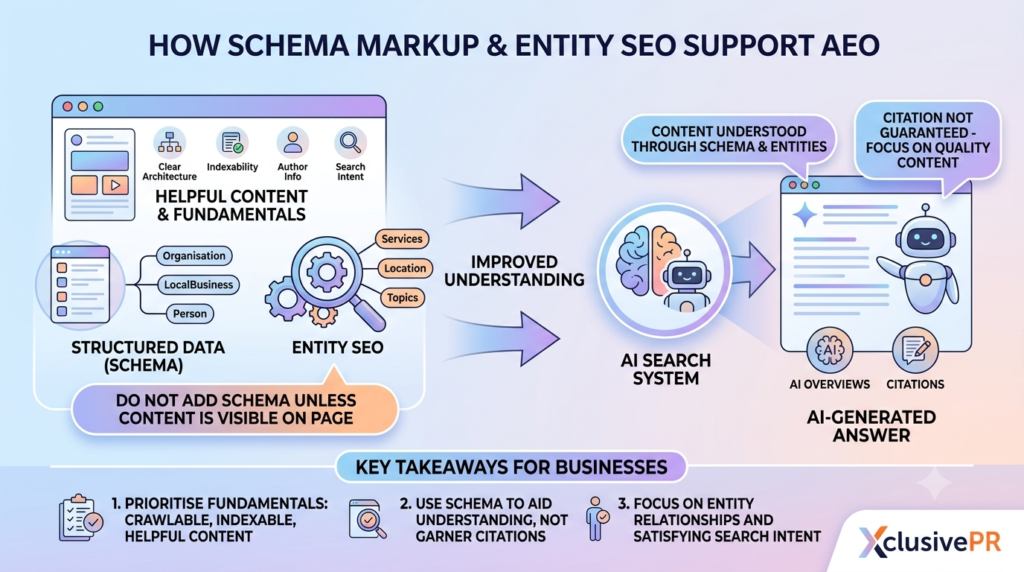
Schema markup can help search engines understand the content and
entities on a website, but it does not guarantee visibility in AI-generated answers.
Schema, also known as structured data, is a standardised way of providing
search engines with additional context about the information on a webpage.
For example, structured data can help communicate that a page represents:
- An organisation
- A person
- A service
- An article
- A local business
- A product
- An event
- A breadcrumb
This additional context can support search engines in understanding what a page and its associated entities represent.
Is Schema Required For AEO?
No.
Google’s current guidance for AI search does not require websites to implement special schema markup to appear in AI Overviews or AI Mode.
The fundamental requirements remain the same: the content needs to be accessible, indexable and useful, while the website should follow established SEO best practices.
That means businesses should not implement schema simply because they believe it will make an AI system cite their website.
Instead, structured data should be used where it accurately describes the visible content on the page.
How Schema Can Support Entity SEO
Structured data becomes particularly useful when thinking about entities.
For example, an organisation’s website might clearly communicate:
XclusivePR
A London-based digital marketing and PR agency.
Its relevant entities could include:
- Organisation
- SEO services
- Digital marketing
- Public relations
- Social media marketing
- Branding
- Online reputation management
- London
- UK
The website can then use appropriate structured data alongside visible content to help search engines interpret those relationships.
The important point is that the markup should reinforce information that already exists.
It should not be used to claim things that the website does not visibly support.
Useful Schema Types For A Business Website
Depending on the page, businesses may benefit from structured data such as:
Organisation
Useful for communicating information about the business itself.
LocalBusiness
Relevant where a business qualifies as a local business and the markup accurately represents its details.
Person
Useful for appropriate expert, author or team information.
Article
Can help describe an article and its associated information.
BreadcrumbList
Can help communicate the relationship between pages within a website hierarchy.
Service
Can describe a service where the implementation accurately reflects the page.
Product
Relevant for eligible product pages.
The correct schema depends on the actual content and purpose of the page.
Don’t Add Schema Just For The Sake Of It
More structured data does not automatically mean better SEO.
Adding irrelevant or inaccurate markup can create confusion and may violate search-engine guidelines.
A useful rule is:
If the information is not genuinely represented on the page, don’t mark it up as though it is.
Structured data should support the user-visible content rather than replace it.
Schema And FAQs
FAQ content deserves particular attention.
Businesses can still create useful FAQ sections to answer genuine customer questions.
However, adding FAQ schema simply because a page contains FAQs does not guarantee enhanced search visibility.
The content itself needs to provide genuine value.
For an AEO article, FAQs can still be extremely useful because they allow businesses to address specific questions clearly and concisely.
The SEO value comes primarily from useful content and satisfying search intent, not from assuming that adding FAQ markup will automatically produce a rich result.
Schema And AI Citations
It is important to separate two concepts:
Understanding
Structured data can provide search engines with additional machine-readable context about a page and its entities.
Citation
It does not guarantee that an AI-powered search system will select that page as a source or cite it in an answer.
There is no reliable formula such as:
“Add Organisation schema + Article schema = AI citation.”
Businesses should therefore avoid agencies or tools that promise guaranteed AI visibility simply because schema has been implemented.
What Should Businesses Prioritise First?
Before implementing advanced structured data, make sure the fundamentals are correct.
Prioritise:
- Crawlability
- Indexability
- Helpful content
- Search intent
- Internal linking
- Clear site architecture
- Strong service pages
- Author information
- Business information
- Relevant external references
- Local SEO where appropriate
- Conversion optimisation
Once these foundations are working properly, structured data can be used to provide additional context where appropriate.
The XclusivePR Approach
At XclusivePR, we treat schema as one component of technical and entity SEO, rather than an AEO shortcut.
Our approach is to first understand:
- What the business does
- Which services matter commercially
- Which entities are important
- What customers are searching for
- How the website is structured
- Which pages need stronger visibility
- What information search engines need to understand
We then use appropriate structured data where it genuinely helps communicate that information.
The objective is not to add as much schema as possible.
The objective is to make the website easier to understand without compromising accuracy.
That principle is important as search evolves.
Because whether a person is reading your website or an AI-powered search system is interpreting it, the underlying information should remain clear, accurate, useful, and trustworthy.
How Can Businesses Optimise for Conversational and Long-Tail Searches?
As search becomes more conversational, people are increasingly asking complete questions rather than entering short keyword phrases.
This creates an important opportunity for businesses.
Instead of optimising content only around keywords such as “SEO agency London”, businesses should also understand the questions, concerns and decisions behind those searches.
What Are Long-Tail Searches?
Long-tail searches are usually more specific and often contain several words that describe a particular need.
For example:
“SEO agency London”
could become:
“What should a small business look for when choosing an SEO agency in London?”
Other examples include:
- How much does SEO cost for a small business in the UK?
- How long does SEO take to generate results?
- Can digital PR improve brand visibility?
- How can a London business improve its Google rankings?
- Is social media marketing worth it for a small business?
- How can my business appear in AI search results?
These searches often reveal much more about the user’s intent.
Focus on the Question Behind the Keyword
The keyword is useful, but the question behind it is even more valuable.
Before creating content, ask:
- What problem is the customer trying to solve?
- What information do they need?
- What concerns could prevent them from buying?
- What would they search next?
- What evidence would help them trust the answer?
- What action might they take after finding the information?
This allows content to support the entire customer journey rather than targeting isolated search phrases.
Use Natural Language
AEO-friendly content should sound like something a knowledgeable person would actually say.
Avoid awkward sentences created purely to insert keywords.
Instead of:
“For the best SEO agency London businesses should choose an SEO agency London provider…”
write naturally:
“Choosing an SEO agency in London requires more than comparing prices. Businesses should consider experience, strategy, technical capability, reporting and evidence of previous results.”
The second version is easier for people to understand and still provides strong semantic context.
Answer Follow-Up Questions
A good answer often creates another question.
For example:
What is AEO?
↓
How is AEO different from SEO?
↓
Does AEO replace SEO?
↓
How can I optimise my website for AI search?
↓
How can I measure AI search visibility?
A strong content strategy anticipates these follow-up questions and provides useful pathways to the next piece of information.
This can be achieved through:
- Clear subheadings
- Related sections
- Internal links
- FAQs
- Supporting articles
- Relevant service pages
Use Semantic SEO
Semantic SEO means building content around the meaning and relationships between concepts, rather than repeatedly using one exact keyword.
For an article about AEO, relevant concepts naturally include:
- AI search
- Google AI Overviews
- AI Mode
- SEO
- Search intent
- Topical authority
- Entity SEO
- Content strategy
- Digital PR
- Social search
- Local SEO
- Brand authority
These concepts help establish the broader subject without resorting to keyword stuffing.
Optimise For Commercial Questions Too
Not every conversational query is informational.
Some indicate that the person is getting closer to making a purchase.
For example:
Informational
“What is digital PR?”
Research
“Does digital PR help small businesses?”
Evaluation
“How much does digital PR cost in the UK?”
Commercial
“Which digital PR agency works with London businesses?”
Your content strategy should cover these different stages.
The closer someone gets to a purchasing decision, the more important it becomes to provide:
- Service information
- Pricing guidance where appropriate
- Case studies
- Reviews
- Experience
- Process information
- Clear CTAs
Don’t Create A Separate Page For Every Question
This is particularly important for AEO.
If ten questions can be answered properly within one comprehensive resource, there may be no reason to create ten separate pages.
Instead:
Group closely related questions together.
Create a dedicated page only when the question represents a substantially different topic, search intent or customer need.
This produces a more useful website and avoids creating large volumes of repetitive content.
Example For XclusivePR
Consider someone searching:
“How can a London business improve its visibility in AI search?”
A useful XclusivePR resource could answer the question while naturally covering:
- Technical SEO
- Helpful content
- AEO
- Topical authority
- Entity optimisation
- Local SEO
- Digital PR
- Social media
- Brand reputation
The reader then has a clear pathway to explore relevant XclusivePR services or supporting resources.
The content answers the question first.
The commercial opportunity comes naturally afterwards.
The Goal Is Relevance, Not Maximum Keyword Coverage
Businesses sometimes try to optimise one article for every possible variation of a keyword.
That can make content repetitive and difficult to read.
A better objective is:
Understand the topic.
Understand the audience.
Understand the questions.
Answer them properly.
Connect the information logically.
Provide a useful next step.
That approach creates content that is more valuable to readers while giving search systems clearer context about the subject.
The XclusivePR Approach
At XclusivePR, we use conversational search as an opportunity to understand customer intent, not simply to generate more keywords.
The process starts with the questions potential customers are asking.
We then connect those questions with:
- Search intent
- Content strategy
- SEO
- AEO
- Internal linking
- Digital PR
- Social media
- Local search
- Conversion opportunities
The result is content designed to answer the customer’s question while creating a natural pathway towards the services and expertise they may need next.
Because the best AEO strategy is not about answering more questions.
It is about answering the right questions exceptionally well.
AEO, EEAT and Brand Trust: Why Credibility Matters in AI Search
Visibility alone does not create trust.
A business can appear in search results and still lose a potential customer if the website looks unreliable, the information feels generic or there is little evidence that the company knows what it is talking about.
This is why experience, expertise, authoritativeness and trustworthiness remain important when creating content for search and AI-powered discovery.
What Does EEAT Mean?
Google uses the concept of E-E-A-T, which stands for:
- Experience — Has the creator or business actually experienced or worked with the subject?
- Expertise — Does the content demonstrate relevant knowledge and competence?
- Authoritativeness — Is the business or creator recognised as a credible source on the subject?
- Trustworthiness — Can people rely on the information and the organisation providing it?
Google describes E-E-A-T as an important concept within its Search quality evaluation framework, with trustworthiness being the most important aspect of the four.
E-E-A-T is not a simple score that a website receives.
It is better understood as a framework for thinking about whether content is genuinely useful and whether the people behind it deserve to be trusted.
Google describes E-E-A-T as Experience, Expertise, Authoritativeness and Trustworthiness, with trust being the most important aspect. Google also makes clear that E-E-A-T itself is not a specific ranking factor, but its systems use a range of signals that help identify helpful, trustworthy content.
Source: Google Search Central
Experience Makes Content More Valuable
Anyone can explain what SEO is.
Far fewer businesses can explain what they have actually learned from implementing SEO campaigns.
That difference matters.
Experience can be demonstrated through:
- Case studies
- First-hand observations
- Campaign examples
- Original research
- Practical lessons
- Client experiences
- Expert commentary
- Real-world examples
For example, instead of simply writing:
“Digital PR can improve brand visibility.”
an experienced agency can explain:
- When digital PR is most useful
- Which types of stories tend to attract attention
- How campaigns are developed
- What businesses should realistically expect
- Which metrics should be monitored
- What common mistakes should be avoided
That turns generic information into practical expertise.
Make Your Experts Visible
Businesses should make it clear who is responsible for important content.
Where appropriate, include:
- Author names
- Professional biographies
- Relevant experience
- Areas of expertise
- Professional profiles
- Editorial information
- Updated dates where relevant
For XclusivePR, this creates an opportunity to develop recognisable experts around subjects such as:
- SEO
- Digital marketing
- AEO
- AI search
- Public relations
- Social media
- Online reputation
Instead of building authority around an anonymous corporate website, the business can demonstrate the people and experience behind its advice.
Case Studies Are Powerful Trust Signals
A potential client does not simply want to know what an agency claims it can do.
They want evidence.
A strong case study can show:
- The client’s original challenge
- The objectives
- The strategy
- What was implemented
- How performance was measured
- The outcome
- Lessons learned
This gives prospective customers a clearer understanding of how the agency operates.
It also allows the agency to demonstrate experience rather than simply describing its services.
Use Evidence Carefully
Trust can be weakened when businesses make large claims without supporting evidence.
Avoid statements such as:
“We guarantee first-page rankings.”
“We can guarantee ChatGPT citations.”
“Our strategy will make Google AI recommend your business.”
These claims are difficult to substantiate and can create unrealistic expectations.
Instead, explain:
- What the strategy is designed to achieve
- Which metrics will be monitored
- What factors influence performance
- What is within the agency’s control
- What cannot be guaranteed
This approach may sound less dramatic.
It is also much more credible.
Build Trust Beyond Your Website
A business’s reputation is not limited to the content it publishes itself.
Potential customers may also look at:
- Google reviews
- Industry publications
- Media coverage
- Business directories
- Professional organisations
- Client testimonials
- Case studies
- Social media
- Third-party references
This is where SEO, PR, social media and reputation management begin to overlap.
A business that makes strong claims on its website but has little evidence elsewhere may create doubt.
A business with consistent expertise across multiple credible channels can provide a much stronger trust experience.
Digital PR Can Support Brand Credibility
Digital PR gives businesses an opportunity to demonstrate expertise beyond their own website.
An expert might contribute commentary to a relevant publication, appear on a podcast or provide insight for an industry article.
The value is not simply the backlink.
It is the opportunity for potential customers to see the business being recognised as a useful contributor within its industry.
For an agency such as XclusivePR, this can become an important part of building long-term brand authority.
Reviews Are Part of the Decision-Making Journey
Reviews are particularly important for local and service-based businesses.
Before contacting an agency, a potential client may look at:
- Overall rating
- Number of reviews
- Recent feedback
- Responses from the business
- Recurring customer experiences
Reviews should always be genuine.
Businesses should never manufacture positive reviews or manipulate customers into leaving predetermined feedback.
Authentic feedback is far more valuable because it gives future customers an insight into what working with the company is actually like.
Keep Your Brand Information Consistent
Trust can also be affected by inconsistencies.
Make sure important information is aligned across your digital presence.
This can include:
- Business name
- Services
- Location
- Contact information
- Team information
- Company descriptions
- Social profiles
- Business listings
For a London agency, for example, the website, social profiles and relevant third-party references should consistently communicate what the company does and the market it serves.
Originality Matters
A business does not build authority by rewriting information that hundreds of competitors have already published.
Ask:
What can we contribute that is genuinely ours?
That could be:
- Original research
- A unique framework
- First-hand experience
- Expert opinion
- New data
- Client lessons
- Industry analysis
- Practical examples
This is particularly valuable for agency websites because potential clients are evaluating the quality of the thinking, not simply the number of services listed.
AI-Generated Content Does Not Replace Expertise
AI tools can help businesses research, structure and develop content.
But using AI does not automatically make content authoritative.
A useful workflow is:
AI assistance
↓
Human expertise
↓
Fact checking
↓
Original insight
↓
Editorial review
↓
Useful final content
The value comes from what the business contributes, not simply from the tool used to produce the first draft.
The XclusivePR Approach
At XclusivePR, we believe strong search visibility should be built on evidence rather than exaggerated promises.
That means combining:
- Expert-led content
- Practical experience
- Case studies
- Original insights
- Digital PR
- Social media
- SEO
- Local visibility
- Reputation management
- Clear business information
The objective is to create a digital presence that does not simply say:
“Trust us.”
It provides potential customers with enough useful information and evidence to reach that conclusion themselves.
And in an environment where customers can research a business across Google, AI search, social media, reviews and media coverage, that level of credibility can be a significant competitive advantage.
The strongest AEO strategy is therefore not just about being discoverable.
It is about becoming a source people have a reason to trust.
Common AEO Mistakes UK Businesses Should Avoid
AEO is still a relatively new area of digital marketing, which means businesses are being exposed to a growing amount of conflicting advice.
Some strategies are useful.
Others are simply traditional SEO tactics given a new AI-focused name.
Before investing in AEO, UK businesses should avoid these common mistakes.
1. Treating AEO as a Replacement for SEO
AEO does not make technical SEO, content quality or website accessibility irrelevant.
Google’s current guidance confirms that the fundamental SEO requirements for appearing in Search also apply to AI-powered search experiences.
Better approach: Build AEO on top of a strong SEO foundation.
2. Creating Content for Every Possible Question
Businesses sometimes assume that answering every variation of a question will increase AI visibility.
This can result in dozens of pages saying essentially the same thing.
Better approach: Group related questions into comprehensive, genuinely useful resources and create separate pages only when there is a meaningful difference in topic or search intent.
3. Publishing Large Volumes of Generic AI Content
AI can make content production much faster.
That does not mean more content automatically means more authority.
Google’s guidance emphasises creating original, useful content for people rather than producing large amounts of content primarily to manipulate search visibility.
Better approach: Use AI where it adds efficiency, but add human expertise, original insights, fact checking and editorial judgement.
4. Keyword Stuffing
Repeating phrases such as:
“AEO agency London”
throughout an article does not make the content more authoritative.
It can make the page harder to read and less useful.
Better approach: Write naturally around the subject, related concepts and genuine customer questions.
5. Chasing Guaranteed AI Citations
No credible agency can guarantee that Google AI Overviews, ChatGPT or another AI system will cite a particular business.
AI-generated results depend on numerous factors and can change over time.
Better approach: Build useful content, technical foundations, expertise, brand recognition and credible external visibility.
6. Thinking Schema Guarantees AI Visibility
Structured data can help search engines understand information on a page.
It does not guarantee an AI citation.
Better approach: Implement schema accurately where it applies and focus first on the quality and accessibility of the underlying content.
7. Ignoring First-Hand Experience
A page that simply repeats information already available across hundreds of websites gives customers little reason to trust the business.
Better approach: Include genuine experience through:
- Case studies
- Expert commentary
- Original research
- Campaign insights
- Practical examples
- Lessons learned
8. Ignoring Brand Reputation
A potential customer may discover your business through search and then investigate it elsewhere.
They may check:
- Reviews
- Social profiles
- Media coverage
- Case studies
- Industry mentions
- Founder or expert profiles
Better approach: Treat SEO, PR, social media and reputation management as connected parts of the customer journey.
9. Measuring Only Rankings and Traffic
AEO can influence how people discover and research a business, but rankings and traffic alone do not tell the whole story.
Businesses should also consider:
- Qualified enquiries
- Conversion rate
- Branded searches
- Service-page engagement
- Consultation requests
- Assisted conversions
- Relevant referral traffic
- AI visibility metrics where reliable data is available
The goal is not simply more visitors.
The goal is more relevant business opportunities.
10. Forgetting the Human Reader
Perhaps the biggest mistake is creating content that sounds as though it was written for an algorithm.
If a potential customer lands on the page and finds it repetitive, vague or overly technical, the optimisation has failed.
Better approach: Write for the customer first.
Make the information:
- Clear
- Useful
- Accurate
- Specific
- Easy to scan
- Supported by evidence
- Relevant to the reader’s situation
Then optimise the technical elements around that genuinely useful content.
The XclusivePR Perspective
AEO should not be approached as a collection of tricks designed to influence AI systems.
It should be treated as part of a broader strategy for building search visibility, authority and trust.
For UK businesses, that means bringing together:
- Technical SEO
- Helpful content
- Search intent
- Topical authority
- Entity SEO
- Digital PR
- Social media
- Local SEO
- Reputation management
- Conversion optimisation
The businesses best positioned for the changing search landscape will not necessarily be the ones publishing the most content.
They will be the ones consistently providing the most useful information, demonstrating genuine expertise and giving customers a reason to trust them.
How to Measure AEO and AI Search Visibility
AEO should be measurable.
But measuring it is different from measuring traditional SEO.
A business should not rely on one metric such as:
“Did an AI mention our company?”
AI search visibility is broader.
The goal is to understand whether your business is becoming more discoverable, relevant and trusted across search and AI-powered discovery.
Start With Traditional SEO Data
Your existing SEO data remains important.
Monitor:
- Organic impressions
- Organic clicks
- Search positions
- Click-through rates
- Organic landing pages
- Search queries
- Organic conversions
Google Search Console remains an important source of this information.
If your pages are gaining visibility for relevant searches, that provides an important foundation for your wider AI search strategy.
Monitor The Questions Your Audience Searches
AEO should also be measured against the questions you are trying to answer.
Track whether your website is gaining visibility around:
- Informational questions
- Commercial questions
- Long-tail searches
- Local searches
- Service-related questions
- Problem-based searches
The objective is not to rank for every possible question.
It is to become increasingly visible for questions that matter commercially to your business.
Track Branded Search Growth
Brand visibility is another useful indicator.
Monitor searches containing your:
- Company name
- Brand name
- Founder names
- Key services
- Brand + location
- Brand + service combinations
For example:
“XclusivePR”
is different from:
“SEO agency London”
If more people begin searching specifically for your brand after encountering your content, social media or PR, that can indicate growing brand awareness.
Monitor AI Citations Where Data Is Available
AI visibility is becoming easier to measure in some environments.
Microsoft’s Bing Webmaster Tools includes an AI Performance report that can show:
- Pages cited in AI-generated responses
- Citation trends
- Grounding queries
- Changes in citation activity
Microsoft makes clear that these metrics are different from traditional rankings and should not be interpreted as a direct measure of authority or traffic.
This is useful because it provides businesses with actual data rather than requiring them to rely entirely on manually testing AI platforms.
Don’t Rely On Manual AI Searches Alone
It can be tempting to repeatedly ask:
“Who is the best SEO agency in London?”
and check whether your business appears.
That can provide anecdotal insight.
But it should not become your primary measurement system.
AI-generated results can vary depending on:
- Query wording
- Location
- Context
- Platform
- Personalisation
- Search history
- Timing
Instead, combine AI visibility observations with measurable website and business data.
Measure Qualified Leads
This is the metric that matters most to a business.
Ask:
Did the visibility generate opportunities?
Track:
- Contact form submissions
- Consultation requests
- Phone enquiries
- Qualified leads
- Sales opportunities
- Conversion rates
- Revenue where attribution is possible
A page generating 500 highly relevant visitors may be more valuable than one generating 20,000 visitors with no commercial intent.
Measure Assisted Conversions
Not every customer converts during their first visit.
Someone might:
- Read your AEO article
- Leave the website
- See your LinkedIn content
- Search your brand later
- Read a case study
- Return through Google
- Contact your business
The original article may have influenced the decision without being the final conversion source.
That is why assisted conversions and broader customer journeys can provide useful context.
Monitor Search Visibility Across Channels
A modern brand can be discovered through:
- Google Search
- AI-powered search
- Bing
- Social media
- Digital PR
- Local search
- Review platforms
- Industry publications
Your measurement framework should therefore look beyond a single ranking report.
Review Performance Regularly
AEO is not a one-time project.
Search behaviour changes.
AI platforms change.
Competitors publish new content.
Google changes its search experiences.
Customer questions evolve.
Review your strategy regularly and identify:
- Which topics are gaining visibility?
- Which pages attract qualified users?
- Which questions remain unanswered?
- Which content needs updating?
- Which pages generate enquiries?
- Which PR campaigns create meaningful attention?
- Which social topics drive brand discovery?
Use those insights to improve the next round of content.
What Should AEO Success Look Like?
There is no single AEO success metric.
A healthy strategy can show progress through several signals:
- Greater visibility for relevant searches
- Increased branded search demand
- Stronger engagement with useful content
- More qualified organic traffic
- Increased AI citations where measurable
- More relevant third-party mentions
- More enquiries
- Better conversion rates
- Stronger brand recognition
The most important question is:
Is your digital presence becoming more useful and more visible to the people who matter to your business?
The XclusivePR Approach
At XclusivePR, we believe AEO reporting should connect visibility with business outcomes.
That means looking beyond:
“How many keywords do we rank for?”
and asking:
- Are we reaching the right audience?
- Are we answering commercially valuable questions?
- Is our brand becoming more recognisable?
- Are people engaging with our expertise?
- Are we generating qualified enquiries?
- Which channels are contributing to those conversions?
AEO should ultimately support the same objective as every other part of digital marketing:
helping the right people discover your business and giving them a reason to become customers.
A Practical 90-Day AEO Strategy for UK Businesses

AEO should not be treated as a one-off content project.
It is an ongoing process of improving how your business is discovered, understood and trusted across search and digital channels.
For a UK business starting from scratch, a practical 90-day roadmap can provide a strong foundation.
Days 1–30: Build the Foundation
The first month should focus on understanding the current digital presence and fixing fundamental issues.
Start With A Technical SEO Audit
Review:
- Indexability
- Crawlability
- Robots.txt
- XML sitemap
- Canonicals
- Redirects
- Broken links
- Mobile usability
- Page speed
- Core Web Vitals
- Website architecture
There is little value in creating large amounts of new AEO content if important pages cannot be properly discovered or indexed.
Analyse Search Intent
Identify:
- Core commercial keywords
- Long-tail searches
- Customer questions
- Local searches
- Competitor gaps
- High-value service topics
Then group these into meaningful topics rather than creating a separate page for every keyword variation.
Audit Existing Content
Review existing pages and ask:
- Is the information still accurate?
- Does the page satisfy the search intent?
- Is anything important missing?
- Does it demonstrate expertise?
- Are there useful internal links?
- Is there a clear next step?
- Does it provide something original?
Improve strong existing content before automatically creating more.
Strengthen Business Information
Make sure the website clearly communicates:
- Who the business is
- What it offers
- Who it serves
- Where it operates
- Who its experts are
- How customers can contact it
Also review important external business profiles for consistency.
Days 31–60: Build Authority
Once the foundations are in place, the focus should shift towards demonstrating expertise.
Build Your Priority Content Cluster
Create a central resource around an important commercial topic.
Then develop supporting content around genuine related questions.
For example, an AEO cluster could include:
- AEO
- AI search
- Google AI Overviews
- GEO
- SEO for AI search
- Social search
- Digital PR
- Entity SEO
- Local SEO
Every page should have a clear purpose.
Add First-Hand Expertise
Strengthen content with:
- Case studies
- Expert commentary
- Original insights
- Campaign experience
- Research
- Practical examples
The aim is to demonstrate knowledge rather than simply repeat information already available elsewhere.
Start A Digital PR Campaign
Identify subjects where the business can provide useful expertise.
Then look for relevant opportunities through:
- Industry publications
- Business media
- Expert commentary
- Interviews
- Podcasts
- Original research
- Thought leadership
The objective should be earned visibility and credibility, not simply acquiring links.
Amplify Content Through Social Media
Turn useful insights into platform-specific content.
For example:
- LinkedIn expert posts
- Short educational videos
- Social carousels
- Founder commentary
- Industry discussions
The aim is to extend the reach of the expertise demonstrated on the website.
Days 61–90: Connect Visibility With Leads
The third month should focus on turning the foundation and authority work into a measurable acquisition system.
Strengthen Internal Linking
Connect:
- Educational articles
- Service pages
- Case studies
- Local content
- Supporting resources
A visitor should be able to move naturally from:
Question → Answer → Expertise → Service → Enquiry
Improve Conversion Paths
Review important pages for:
- Clear CTAs
- Consultation opportunities
- Contact forms
- Phone numbers
- Case studies
- Testimonials
- Trust signals
- Relevant service links
Do not make every page aggressively promotional.
The CTA should match the visitor’s intent.
Strengthen Local Visibility
For businesses serving specific locations:
- Optimise Google Business Profile
- Encourage genuine reviews
- Maintain accurate business information
- Build relevant local citations
- Publish useful local content
- Develop local PR opportunities
- Strengthen location and service relevance
For London businesses, genuine local expertise can be particularly valuable in highly competitive markets.
Measure The Results
Review:
- Organic visibility
- Search impressions
- Organic clicks
- Branded searches
- Qualified traffic
- Conversions
- Enquiries
- AI citations where measurable
- Third-party mentions
- Assisted conversions
Do not expect every metric to improve immediately.
The purpose of the first 90 days is to establish a stronger foundation and identify where the greatest opportunities exist.
What Happens After 90 Days?
AEO should then become part of your ongoing marketing strategy.
Continue to:
- Refresh important content
- Publish genuinely useful resources
- Monitor customer questions
- Build expert profiles
- Develop digital PR
- Distribute content through social media
- Strengthen internal linking
- Improve conversion paths
- Monitor search visibility
- Review AI-search developments
- Update outdated information
The strategy should evolve as your customers, competitors and search behaviour change.
AEO Should Be Built Around Your Business
There is no universal 90-day AEO checklist that will work equally well for every company.
A local restaurant will have very different priorities from a London law firm.
An e-commerce company will need a different content and entity strategy from a healthcare provider.
A professional services business may need to place greater emphasis on expert-led
content, reputation and digital PR.
That is why the first step should always be understanding:
- Your business model
- Your target audience
- Your services
- Your location
- Your competitors
- Your existing authority
- Your current search visibility
- Your commercial goals
The XclusivePR Approach
At XclusivePR, we would not begin an AEO campaign by simply producing a list of AI-search keywords.
We would first assess the entire digital ecosystem.
That can include:
Technical SEO
Can search engines access and understand the website?
Content
Does the business provide genuinely useful information?
Topical authority
Does the website demonstrate meaningful expertise?
Entity visibility
Is the business clearly represented across relevant digital properties?
Digital PR
Is the brand contributing expertise beyond its own website?
Social media
Is that expertise reaching the right audience?
Local SEO
Is the business visible and credible in its target locations?
Conversion optimisation
Can interested visitors easily become enquiries?
The result is a strategy built around the business rather than around a passing SEO trend.
The 90-Day Goal
The goal of the first 90 days should not be:
“Get our business mentioned by AI.”
It should be:
Build a stronger digital presence that search engines, AI-powered
experiences, and potential customers can understand and trust.
Once that foundation is in place, visibility becomes easier to build, measure and improve.
And most importantly, the strategy can begin contributing to what matters most to a business:
qualified leads and sustainable growth.
Frequently Asked Questions About AEO
What is AEO in digital marketing?
AEO, or Answer Engine Optimisation, is the practice of creating and
structuring useful information so that search engines and AI-powered
search experiences can better understand and surface relevant answers
to users’ questions.
Is AEO the same as SEO?
No. SEO focuses broadly on improving a website’s visibility in search
engines, while AEO focuses more specifically on providing clear,
useful answers to questions. The two strategies work together rather
than replacing one another.
Does AEO replace traditional SEO?
No. Technical SEO, helpful content, internal linking, crawlability,
indexability and other SEO fundamentals remain important for
AI-powered search. AEO should be treated as part of a broader SEO
strategy.
How long does AEO take to work?
There is no fixed timeframe. Results depend on factors such as website
authority, competition, content quality, technical SEO, search demand
and existing brand recognition. AEO should be viewed as a long-term
visibility strategy rather than a quick ranking tactic.
Can AEO help local businesses?
Yes. Local businesses can combine AEO with local SEO to answer
location-specific and service-related questions. Google Business
Profile optimisation, reviews, local content, service pages and
relevant digital PR can all contribute to a stronger local presence.
Does schema markup guarantee AI visibility?
No. Structured data can help search engines understand information on
a page, but it does not guarantee inclusion in AI-generated answers.
Schema should accurately describe information that is already present
on the page.
Can social media improve AEO?
Social media should not be treated as a direct ranking shortcut.
Its value comes from distributing expertise, increasing brand
discovery and creating more opportunities for people to encounter and
research a business. It works best as part of a wider SEO, content and
PR strategy.
Can digital PR help with AEO?
Digital PR can support broader brand visibility and credibility by
creating opportunities for businesses and experts to appear in
relevant publications, interviews and industry discussions. It does
not guarantee AI citations, but it can contribute to a stronger
overall digital presence.
How can I measure AEO?
AEO can be assessed using a combination of organic search visibility,
search queries, branded searches, qualified organic traffic,
conversions and AI citation data where reliable measurement is
available. The most important metrics should ultimately connect
visibility with business outcomes.
Should businesses use AI to create AEO content?
AI can assist with research, organisation and content development, but
businesses should add human expertise, fact checking, original
insights and editorial judgement. The objective should be genuinely
useful content, not mass-produced pages created solely to target
search queries.
